# Hack-Along
Collaborative hacking patterns to co-create on planet earth
We’ve been conditioned to believe in the myth of the survival of the fittest: In this view, each one of us struggles against all the others for scarce resources. The strongest ones survive and pass on their genes, while the weak loose and die out. Outside of our family environment, this way of thinking seems to be reflected in every interaction in our so-called civilised society.
However, nature is much more about collaboration than competition. The very concept of an ecosystem brings every piece of the puzzle in an harmonious interconnection.
To resolve the greatest challenges of our time, we need a fresh new modus-operandi which starts from a sharing and collaborative endeavour.
People Hacking-along are moving away from a competition mindset embedded in scarcity, and aim towards collaborating at the local and global level in creating a mindset of abundance.
## So what's an Hack-Along?
An hack-along is a prescriptively non-prescriptive event, so it is quite difficult to give a straight answer to this question.
Participants are not bound to any pre-requisite rules they did not choose for.
Therefore, first rule of an hack-along is: we don't talk about the rules of an hack-along!
{% hint style="info" %}
**Rules** are coercive patterns by nature. They are decisions taken by a small group of people that are aimed to affect a greater group. They often come in bulk, they tend to be very difficult to change. You are generally not able to consent to a few rules while rejecting others. As such, it is not advisable to use them.
{% endhint %}
There is however an experimented list of "patterns" that participant have successfully used in the past. This handbook functions as a repository of these patterns for you to explore and to pick up. Every person, groups and locations running an hack-along chooses which patterns to adopt, or can propose new ones.
For instance, here is an opinionated list of values that could be used to guide hack-alongs:
**Consent over Consensus:** we don't need to agree on everything. If 49% disagrees on something, they shouldn't be forced to do it because "the majority" wants the opposite. Consent means you allow other people to go on with their idea, because you don't have any blocking objection.\
\
**Non-coercive:** no-one can tell participants what to do and when, unless they consent to that.
**Intrinsically Motivated Contributions:** every contribution is strengthen by the motivation that only the participant's life experience can. Participants should follow their bliss, contributing to the specific issues they want to see fixed in the world.
**Globally Synchronous, Locally Asynchronous:** Everyone choose what and when and where to do it, but we do have specific moments in which everyone show and tells. The moon is an indisputable world-wide progress bar is up in the night sky. You can use this to align your hack-with other people, wherever they are, without ever needing to set a dates again.
### Find a project you like, or start a new one!
You can use the [asynchronous forum](https://async.hackalong.io/) to find and join projects that match your vision of the future, and help them out how only you can. You don't need to ask permissions, just pick up anything and use your skills to improve on the works of others, when existing contributors recognise your contributions by accepting a pull request, you will automatically be part of the team!
Do you have a great idea or project yourself? Then just propose it and keep your eyes open for people who are willing to hack-along with you!
Hack-along projects are open source and forked on the hack-along [github](https://github.com/hack-along). As such, you will mainly find projects and tools that focus on the infrastructure on how to collaborate in the most effective ways at the local and global level. They tend to focus on the co-creation of tools and technologies for sharing and collaborating, and thriving but anything that is open and useful for the planet and the people living on it will do!
If at any time you feel lost, ask for help on our [discord server](https://discord.gg/zucJ4ssXtd) or rabbit-hole yourself down into the deepest parts of the hack-along [forum](https://async.hackalong.io/).
Happy collaborative hacking!
# Crew Formation
[**CC-BY-SA**](https://creativecommons.org/licenses/by-sa/2.0/) **credit Richard Bartlett @ TheHum.org**
A **Crew** is a small group up to about 8 people growing trust in each other through emotional & economic reciprocity. Crews are always designed for intimacy, and may also produce an output (e.g. a software product or an activist campaign).
How is Crew formed? We're not sure. Richard suggests the best way to meet your Crew-mates is in a Congregation: a larger gathering of people with some shared values and medium-high trust.
The following is a collection of patterns for people to support each other in small peer-to-peer mutual aid groups:
* **Pods**: personal-and-professional development in small groups, a new practice in development at Enspiral. Comprehensive [resources here](http://handbook.enspiral.com/guides/pods.html). (For more on this: listen to the [recording of the Crews/Pods session at Enspiral Summer Retreat 2019](https://www.microsolidarity.cc/discussing/enspiral-summer-retreat-feb-2019); and [this update 6 months later](https://anchor.fm/Microsolidarity/episodes/Nati-and-john-talking-about-pods-at-Enspiral-e9giqj).)
* [Case Clinic](https://www.presencing.org/resource/tools/case-clinic-desc) is a peer-coaching method from Theory U. It has a practical output (helping someone with a challenge they're currently facing), and it tends to produce a lot of insight and interpersonal bonding. It's an excellent place to start, you can get a long way in one meeting.
* [Feelz Circle](http://emotionalanarchism.com/how-to-form-a-radical-feelz-circle/): 3 processes for sharing emotional care between friends/ comrades/ lovers.
* The [Circle of Trust](http://www.couragerenewal.org/approach/) approach from Parker Palmer and the Center for Courage and Renewal. Includes some guidance for cultivating a safe space for vulnerable conversations, plus great descriptions of why this is valuable.
* [Pods and Pod Mapping](https://batjc.wordpress.com/pods-and-pod-mapping-worksheet/) by Mia Mingus for the Bay Area Transformative Justice Collective. In this context, your pod is "the people that you would call on if violence, harm or abuse happened to you; or the people that you would call on if you wanted support in taking accountability for violence, harm or abuse that you’ve done"
* [Metagame Mastermind](https://www.youtube.com/watch?v=aDWuHsyznf4?t=753): a kind of stoic crew. 3 people, 3 week sprints, 3 commitments (one life practice (e.g. meditate daily), one renouncement (e.g. no sugar), one gift to the world).
* [Action Circles](https://www.bethechangeearthalliance.org/action_circles) ( by Be The Change Earth Alliance)support people who want to change their life to be more ecologically sustainable. They have a comprehensive [best practice guide](https://www.bethechangeearthalliance.org/circle_guide) for convening these circles, including sample agendas, facilitation and communication tips, etc.
* [Faerie Rings](https://hackmd.io/0iNeYQ9wR3qqerxjvfKnhg) (by the [Scuttlebutt](http://scuttlebutt.nz) software community)
Documentation currently focusses on how to do matchmaking to form crews within a congregation. Faerie Rings are mostly "get to know you" spaces for people who are participating in a big distributed project, but don't have many opportunities to connect face to face.
* [The Elephants](https://medium.com/things-ive-written/the-elephants-182870501589) long term personal development for Crews, focussed on goal-setting and accountability.
* [Working Out Loud](https://workingoutloud.com/en/circle-guides): a guided 12-week process for peer support in small groups, suitable for workplaces: *what am I trying to do? who is related to that goal? how can I contribute to them to deepen our relationship?*
* [Stewardship](https://loomio.coop/stewarding.html) peer support system for Partnerships.
* [How to give feedback in a small peer group](https://qualityswdev.com/2017/01/22/how-to-give-and-receive-feedback-in-an-agile-organization/). Written by Manuel Küblböck for a professional context, but the principles apply transcontextually.
* [How to host an Empathy Circle](http://cultureofempathy.com/Community/Handouts/How-To-Empathic-Listening.htm) - a simple group process to strengthen your empathy muscles.
* [Working Out Loud support circles](https://workingoutloud.com/en/circle-guides)
# Conscious Organizational Map
Where are you and your team at?
This map embeds concepts of spiral dynamics and integral theory, applying them to teams of people. It can be used to analyse the consciousness level of an organisation and to shows the strengths and areas with most growth potential
After you have formed a crew or started collaborating with others, you can give this map to your crew and ask them to draw a line between the patterns you see at play. Bring the different prospectives together and have a discussion on what could be improved and how.
# Co-Living Patterns
"The knifes are in the kitchen"
Working together might mean eating together and spending a lot of time with each other. These could be considered as temporary communities, and although it works well when everyone is excited of being part of such, it is easy to fall out of grace.
Washing the dishes, cooking, sharing the food, cleaning the toilets, norms of behaviours that should be widely recognised are often the beginning of the end of a group of people, and the projects might be heavily affected by this physical situation.
The co-living patterns are here to help on this fundamental aspect, they are game or processes which aid maximising the benefits of being together, while minimising all the drama that could come with it. These patters are there to avoid having to deal with the eons-old "free-rider" problem
# Did this
A transparency practice where community members self-attest their contributions on a shared board, creating visibility of collective effort and enabling peer validation in a trust-based system.
## Overview
"Did this" is a contribution tracking pattern that moves away from command-and-control task management toward a peer-to-peer attestation network. Anyone writes what they did for the community on a board, self-attesting what they contributed. The board can be reviewed at regular intervals (typically weekly), where attestations can be discussed, validated, or questioned by the group.
This pattern supports regenerative resource flows by making contributions visible, creating social accountability, and establishing the foundation for equitable distribution of collective resources, tokens, or recognition.
## Why Use This Pattern
**Transparency Over Surveillance:** Rather than requiring permission or reporting to authority figures, contributors autonomously share their work, fostering intrinsic motivation and trust.
**Peer Validation:** The community collectively witnesses and validates contributions, building mutual recognition and preventing both under-reporting (invisible labor) and over-claiming.
**Resource Distribution:** When communities distribute flow tokens, time credits, or other rewards, visible contributions provide the basis for equitable allocation without complex tracking systems.
**Cultural Shift:** This pattern embodies the transition from extractive transactions (work for pay) to regenerative exchanges (contribution toward collective needs with shared abundance).
## Implementation
### Setting Up the Board
**Physical Board:** Use a whiteboard, corkboard, or wall space in a common area where people naturally gather. Divide it into sections by week, category (e.g., kitchen, garden, admin, creative), or contributor.
**Digital Board:** Use tools like:
* Shared documents (Google Docs, Notion, HackMD)
* Project boards (Trello, GitHub Projects)
* Community forums with a dedicated "Contributions" category
* Blockchain-based attestation systems for permanent, verifiable records
**Hybrid Approach:** Maintain both physical presence (for visibility and culture-building) and digital backup (for remote members and permanent record).
### What to Include
Each attestation should capture:
* **What was done** - Brief description of the contribution
* **When** - Date or time period
* **Who** - Name or identifier of contributor
* **Impact** (optional) - Who benefited, what need was met, or what outcome was achieved
* **Resources used** (optional) - Materials, time, or support from others
Example attestations:
* "Harvested apples from the orchard, sorted and stored in root cellar - 3 hours - Alex - 2025-11-15"
* "Facilitated conflict resolution session for kitchen crew - 2 hours - Jordan"
* "Repaired solar panel connection, restored power to workshop - 1 hour - Casey - Enabled 3 other projects to continue"
### Review Rhythm
**Weekly Check-ins:** Gather the community (or those interested) to review the board together. This can be part of a regular meeting, sharing circle, or meal time.
**What to Look For:**
* Celebrate visible contributions and express gratitude
* Notice patterns in where energy is flowing
* Discuss any attestations that seem unclear or questionable
* Identify invisible labor that might not be appearing on the board
* Recognize those who consistently contribute in ways that support others
**Addressing Concerns:** If an attestation seems inaccurate or inflated, approach with curiosity rather than accusation. Often misunderstandings arise from different perceptions of effort or value. Use the discussion to align on what the community values and how to represent it.
## Connection to Regenerative Systems
This pattern directly supports REGENERATIVA's vision of multi-resource accounting:
**Contribution Visibility:** Makes labor, expertise, and care work visible alongside financial contributions, creating a more complete picture of how value flows through the community.
**Flow Token Distribution:** Provides the data needed to distribute monthly flow tokens to those contributing toward collective needs, creating universal optionality across the network.
**Negative Externalities as Inputs:** When someone attests to solving a problem (fixing broken infrastructure, healing conflict, cleaning up waste), it reveals what challenges exist and how Holons are transforming externalities into addressed needs.
**Trust Building:** Self-attestation with peer review builds the trust infrastructure needed for decentralized coordination at scale.
## Tips for Success
**Start Simple:** Don't over-engineer the system. A simple shared document or physical board is enough to begin. Add complexity only as needed.
**Celebrate Small Contributions:** Washing dishes, sweeping floors, and holding space in conversations are as worthy of attestation as larger visible projects.
**Track Non-Labor Contributions:** Someone who offers their land, tools, or materials is contributing resources even if they're not doing physical work.
**Include Care Work:** Emotional labor, facilitation, conflict resolution, and nurturing activities are often invisible but essential. Make them visible.
**Avoid Gamification:** The goal is transparency and peer recognition, not competition for who contributed most. If the pattern starts creating unhealthy comparison, revisit the intention together.
**Connect to Distribution:** If the community distributes resources, tokens, or rewards, clearly connect attestations to allocation criteria. Transparency in both contribution and distribution builds trust.
## Variations
**Buddy Validation:** Pair with the Task Buddy pattern - buddies attest to each other's contributions, adding a layer of peer validation.
**Category-Based:** Organize attestations by type of contribution (food production, infrastructure, education, healing, governance) to see where community energy is focused.
**Impact Scoring:** Add community-driven metrics for how much a contribution met collective needs (used in some gift economy systems, but be cautious of over-quantification).
**Blockchain Integration:** For networks coordinating across multiple Holons, immutable contribution records enable trustless resource distribution and reputation building.
## Related Patterns
* **Task Buddy:** Mutual attestation between pairs working together
* **Appreciative Scoring:** Peer feedback and recognition system
* **Offers and Requests:** Complements attestation by making needs and capacities visible before action
* **Flow Token Distribution:** Uses contribution data to allocate collective resources
By making contributions visible through self-attestation and peer review, communities build the transparency and trust needed for regenerative resource flows, where every member's contributions create ownership, optionality, and collective abundance.
# Offers and Requests
A resource-matching pattern where community members make their needs and capacities visible on a shared board, enabling organic connections, mutual aid, and the emergence of collective abundance.
## Overview
Put up a digital and/or physical board where anyone can post something they need or would like (Requests), and anything they could contribute (Offers). This simple practice creates a marketplace of gifts and needs, allowing resources, skills, time, materials, and knowledge to flow where they're most valued.
Rather than relying on centralized resource allocation or leaving needs unmet due to lack of awareness, Offers and Requests creates transparency that enables peer-to-peer matching. When offers meet requests, value is exchanged directly between community members without requiring intermediaries, currency, or complex coordination.
## Why Use This Pattern
**Makes Abundance Visible:** Often communities have untapped resources, skills, and capacity that go unused because people don't know who has what to offer. This pattern reveals hidden abundance.
**Creates Demand Signals:** Requests show what the community actually needs right now, allowing contributors to direct their energy toward real, expressed needs rather than assumptions.
**Enables Mutual Aid:** Those with capacity can directly support those with needs, building reciprocity networks and social bonds.
**Supports Gift Economy:** By making offers without explicit exchange requirements, communities can experiment with gifting, generosity, and trust-based resource sharing.
**Resource Coordination:** Aligns with REGENERATIVA's vision where collective subscriptions create demand signals, and contributors respond with solutions through three pathways: Purchase, Produce (become a production center), or Attract (pool resources collectively).
## Implementation
### Setting Up the Board
**Physical Board:** Use a bulletin board, whiteboard, or wall in a common area with two clear sections:
* **Offers** (left or top section) - "I have" / "I can provide"
* **Requests** (right or bottom section) - "I need" / "I'm looking for"
Consider using different colored cards or markers to distinguish between categories:
* Skills & time (blue)
* Physical objects & materials (green)
* Space & infrastructure (yellow)
* Knowledge & learning (purple)
* Emotional support & care (pink)
**Digital Board:** Create accessible online boards using:
* Community forums with "Offers" and "Requests" categories
* Shared spreadsheets with clear columns
* Project management tools (Notion, Airtable)
* Dedicated platforms (Buy Nothing groups, Time banks, Resource sharing apps)
* Blockchain-based coordination tools for multi-Holon networks
**Hybrid Approach:** Maintain both physical and digital presence to serve both local (face-to-face) and distributed (remote) community members.
### How to Post Offers
**Be Specific:** Instead of "I can help with gardening," write "I can help plant winter crops on Saturday mornings" or "I have 20 seed packets for cold-weather vegetables."
**Include Constraints:** Mention any limitations - "I can offer carpentry skills, but only evenings and weekends" or "I have a spare room available for short-term stays (up to 2 weeks)."
**Update Regularly:** Remove or mark offers that are no longer available. Nothing erodes trust faster than responding to an offer that's already been claimed.
**Examples of Offers:**
* "Offering sourdough bread baking lessons - can teach up to 3 people"
* "I have a truck available for hauling - can help with material transport on weekends"
* "Offering conflict mediation skills - available for one-on-one or group sessions"
* "I can provide childcare Tuesday and Thursday afternoons"
* "Extra harvest from my garden - tomatoes, cucumbers, herbs - take what you need"
### How to Post Requests
**Be Clear About Needs:** Specify exactly what you're looking for and why. Context helps people understand how they might contribute.
**Differentiate Urgency:** Mark time-sensitive requests clearly ("Need by Friday") versus ongoing needs ("Looking for eventually").
**Open to Solutions:** Sometimes you don't know exactly what you need. "Looking for help organizing a workshop - open to ideas" invites creative responses.
**Examples of Requests:**
* "Need someone to review grant proposal - due next Monday"
* "Looking for bike repair tools - just for a few hours"
* "Seeking someone to practice Spanish conversation with"
* "Need help moving furniture on Saturday morning - can offer lunch and gratitude"
* "Looking for scrap wood for building raised garden beds"
### Making Connections
**Direct Contact:** Include a way to reach you (name, contact method, or "see me at dinner").
**Respond Promptly:** When you see a match, reach out quickly. Resource needs often have timing components.
**Document Exchanges:** After a successful match, consider noting it on the board or in a shared log. This creates visibility of mutual aid in action and builds trust.
**Express Gratitude:** Publicly thank those who fulfill requests. This positive reinforcement strengthens the culture of generosity.
## Connection to Regenerative Systems
This pattern directly enables REGENERATIVA's three pathways for meeting needs:
**1. Purchase Pathway:** When someone posts "I need solar panels for my workshop," another might respond "I sell/install solar - here's my offer." Money flows in, supports the network, and the need is met.
**2. Produce Pathway:** If multiple requests appear for the same solution (e.g., "need fresh bread," "looking for baked goods," "want to learn bread-making"), this creates a demand signal. Someone might respond by becoming a production center, using open-source recipes, and serving those subscribers automatically.
**3. Attract Pathway:** When a request is too large for one person (e.g., "community needs a root cellar for food storage"), multiple offers can pool together - someone offers land, another offers labor, another offers materials, another offers expertise - and the resource manifests collectively.
**Demand Signals for Collective Needs:** Recurring requests reveal systemic needs. If five people request the same thing, that's a signal for the community to create a shared solution rather than five individual ones.
**Multi-Resource Exchange:** The board naturally reveals that value flows in many forms - not just money, but labor, materials, knowledge, space, time, and care. This aligns with blockchain-based multi-resource accounting in regenerative economies.
## Tips for Success
**Normalize Requesting:** Many people feel uncomfortable asking for help. Create a culture where expressing needs is seen as a gift - it gives others the opportunity to contribute.
**Encourage Small Offers:** You don't need to offer something extraordinary. "I can listen if you need to talk" or "I have 30 minutes to help" are valuable.
**Review Regularly:** Dedicate time in community meetings to read the board aloud. This keeps everyone aware of current offers and requests.
**Celebrate Matches:** When an offer meets a request, acknowledge it. "Jordan's truck helped Alex move the lumber for the new workshop - thank you both!" This positive feedback loop encourages more participation.
**Notice Patterns:** If certain types of requests never get met, that reveals gaps in community capacity. If certain types of offers go unclaimed, that reveals either abundance (great!) or lack of awareness.
**Avoid Debt Dynamics:** This isn't barter (I do this for you only if you do that for me). Keep exchanges generous and trust-based. The community as a whole balances out over time.
**Connect to Other Patterns:** Use with "Did this" to track fulfilled requests as contributions. Use with Task Buddy to respond to requests together. Use with Flow Tokens to recognize those who consistently fulfill community requests.
## Scaling Across Networks
**Local Holons:** Each community (Holon) maintains its own Offers and Requests board for internal resource matching.
**Inter-Holon Coordination:** Digital boards can connect multiple Holons, allowing surplus from one community to meet deficits in another. This creates interdependent networks rather than isolated communities.
**Subscription-Based Needs:** Collective requests (e.g., "our community needs 100 lbs of organic flour monthly") become subscriptions, creating stable demand signals for producers.
**Open-Source Solutions:** When someone produces a solution to meet collective requests, they can open-source it under regenerative licenses, allowing other Holons to adopt or adapt it.
## Variations
**Categorized Boards:** Separate sections for different types of resources (skills, materials, space, time, knowledge, care).
**Time-Banking Integration:** Track exchanges and create reciprocal time credits for those who prefer structured exchange.
**Gift Economy:** Make all offers unconditional gifts without expecting anything in return - trust that the community will support you when you have needs.
**Blockchain Coordination:** For distributed networks, use smart contracts to match offers to requests across multiple Holons, with automated flow token distribution to those who fulfill collective needs.
## Related Patterns
* **Did this:** Track fulfilled requests as contributions
* **Task Buddy:** Partner up to fulfill larger requests together
* **Open Space:** Surface community needs and self-organize to meet them
* **Consent Decision Making:** Decide which collective requests to prioritize
* **Navigate via Tension:** Express unmet needs as tensions that drive community evolution
By making offers and requests visible, communities create the conditions for organic resource matching, mutual aid, and the emergence of local abundance - establishing sufficiency within before seeking external trade, exactly as regenerative economics envisions.
# Lunar Rhythms
Coordinate community rhythms through lunar cycles and seasonal gatherings, creating globally synchronous yet locally asynchronous flow aligned with natural time.
Use the moon's phases and seasonal cycles to coordinate community activities, creating a natural progress bar visible worldwide that enables synchronization without imposed schedules.
## Overview
Lunar rhythms replace arbitrary calendar dates with natural cycles that everyone on Earth can see in the night sky. The moon becomes a shared "progress bar" - new moon signals beginnings, full moon signals completion, and the cycle repeats predictably every 29.5 days.
This creates **globally synchronous, locally asynchronous** coordination: communities worldwide move through the same rhythm without needing to schedule specific dates, times, or meetings. Each person and Holon chooses *what* to do and *when* during the cycle, but everyone shares common gathering points at new and full moons.
## Why Use Lunar Rhythms
**Natural Time:** Aligns human activity with celestial cycles rather than arbitrary industrial calendars.
**Universal Visibility:** Everyone can see the moon. No apps, internet, or shared calendars needed.
**Cultural Resonance:** Most human cultures historically oriented around lunar cycles - this practice reconnects with ancestral wisdom.
**Removes Scheduling Friction:** No more "what date works for everyone?" Just "full moon" or "new moon."
**Enables Distributed Coordination:** Communities across time zones and geographies can coordinate without real-time communication.
**Creates Rhythm Without Coercion:** People choose their activities freely, but share common pulse with others.
**Integrates Feminine Cycles:** Many people with menstrual cycles naturally attune to lunar phases, honoring embodied rhythms.
## The Basic Cycle
### New Moon (Dark Moon) - Beginnings
**Energy:** Introspection, intention-setting, planning, initiating new projects
**Community Activities:**
* Set intentions for the coming lunar cycle
* Propose new projects or initiatives
* Reflect on what wants to be created
* Plant seeds (literal and metaphorical)
* Gather inward, quiet contemplation
**Regenerative Context:**
* Holons express new needs for the coming cycle
* Contributors propose solutions they'll work on
* New subscriptions or collective requests are posted
* Flow token distribution for previous cycle
### Waxing Moon (Growing) - Building
**Energy:** Growth, expansion, action, building momentum
**Community Activities:**
* Work on projects initiated at new moon
* Build, create, develop, produce
* Energy increases toward full moon
* Collaboration intensifies
* Outward focus on manifestation
**Regenerative Context:**
* Active production toward subscriptions
* Building solutions to meet community needs
* Creating open-source designs
* Growing gardens, building infrastructure
### Full Moon - Completion & Celebration
**Energy:** Culmination, harvest, sharing, celebration, visibility
**Community Activities:**
* Show and tell what's been created
* Celebrate completions
* Gather for full moon circles, sharing, music, dance
* Maximum visibility of work accomplished
* Gratitude and recognition
**Regenerative Context:**
* Present completed solutions
* Demonstrate prototypes
* Share harvest (literal and metaphorical)
* Attest to contributions via "Did this"
* Celebrate those who met community needs
### Waning Moon (Decreasing) - Integration
**Energy:** Rest, reflection, processing, composting, letting go
**Community Activities:**
* Integrate lessons learned
* Rest and recover
* Process emotions and experiences
* Release what's no longer serving
* Quiet, inward energy
* Prepare for the next new moon
**Regenerative Context:**
* Review what worked and what didn't
* Process feedback on solutions
* Compost failed experiments
* Clear negative externalities
* Prepare for next cycle's intentions
## Seasonal Gatherings
**In addition to lunar rhythms, align with seasonal cycles:**
### Winter Solstice (December) - Deep Rest
**Longest night, maximum darkness, deep introspection**
* Gather for reflection on the full year
* Rest, dream, envision
* Plan for coming year
* Storytelling and wisdom-sharing
### Spring Equinox (March) - Emergence
**Equal day and night, balance, planting season**
* Initiate year's major projects
* Plant gardens
* Energy returns after winter rest
* New beginnings
### Summer Solstice (June) - Peak Activity
**Longest day, maximum light and energy**
* Peak production and creation
* Outdoor gatherings and celebration
* Abundance and overflow
* Major collaborative projects
### Autumn Equinox (September) - Harvest
**Equal day and night, balance, harvest time**
* Gather literal and metaphorical harvests
* Give thanks and recognize contributions
* Store and preserve for winter
* Complete year's projects
## Implementation
### Personal Practice
**Track the moon's phases:**
* Use a lunar calendar (apps, printed calendars, or just look at the sky)
* Notice how you feel during different phases
* Align your activities with lunar energy (create during waxing, rest during waning)
* Journal at new and full moons
**Menstrual Cycle Alignment:**
* Many people find their menstrual cycles sync with the moon over time
* New moon menstruation (bleeding with the dark) vs. full moon menstruation
* Honor body's wisdom and natural rhythms
### Community Practice
**Establish simple rhythm:**
* **New Moon Circles:** Gather to set intentions, express needs, propose projects
* **Full Moon Gatherings:** Gather to share completions, celebrate, attest contributions
* Everything between is locally asynchronous - each person works when/how they choose
**Example Community Schedule:**
* **New Moon (Sunday evening):** Community circle to set intentions for cycle
* **Full Moon (two weeks later):** Potluck, show-and-tell, sharing circle, gratitude
* **Repeat monthly**
### Multi-Holon Networks
**For distributed networks coordinating across communities:**
**Shared Rhythm:** All Holons in the network use the same lunar calendar
**Local Interpretation:** Each Holon decides how to embody the rhythm (in-person gathering, online calls, asynchronous forums)
**Cross-Pollination:** Share what's emerging at new moons, share what's completed at full moons, across the whole network
**Seasonal Convergences:** Potentially gather multiple Holons together at solstices/equinoxes for larger coordination
## Connection to REGENERATIVA Framework
**Theos Protocol Coordination:**
* New moon: Communities post subscription needs for upcoming cycle
* Waxing moon: Creators develop solutions
* Full moon: Solutions presented, open-sourced, and distributed
* Waning moon: Integration and feedback
**Flow Token Distribution:**
* Full moon: Attest to contributions
* New moon: Calculate and distribute flow tokens for previous cycle
* Creates predictable rhythm for resource flows
**Holon Organization:**
* Each Holon expresses needs at new moon (inputs)
* Each Holon presents solutions at full moon (outputs)
* Negative externalities identified during waning moon become new moon needs
**Natural Pace:**
* Honors that humans aren't machines running 24/7
* Creates sustainable rhythm of activity and rest
* Prevents burnout common in always-on digital culture
## Practical Examples
### Example 1: Solo Creator
**New Moon:** "I'm going to develop open-source plans for a composting toilet this cycle."
**Waxing Moon:** Research, design, prototype, test, document.
**Full Moon:** Share plans on community forum, license under regenerative terms, celebrate completion.
**Waning Moon:** Receive feedback, rest, let creative well refill.
### Example 2: Community Garden
**New Moon:** "This cycle we'll prepare beds for spring planting."
**Waxing Moon:** Build beds, amend soil, gather seeds and starts.
**Full Moon:** Planting party! Celebrate prepared beds, potluck with food from last harvest.
**Waning Moon:** Let seeds germinate, trust the process, tend gently.
### Example 3: Distributed Network
**New Moon (simultaneously worldwide):** Each Holon posts needs on shared platform.
**Waxing Moon:** Creators across the network respond to needs, develop solutions locally.
**Full Moon (simultaneously worldwide):** Virtual gathering to share what's been created, cross-pollinate ideas.
**Waning Moon:** Integrate, rest, prepare for next cycle.
## Variations
**Weekly Rhythm:**
* For communities needing faster iteration
* Map lunar phases to weeks: Monday (new), Wednesday (waxing), Friday (full), Sunday (waning)
**Bi-Lunar:**
* Some communities might use two-month cycles (two full moons) for larger projects
* Gives more time for complex initiatives
**Custom Markers:**
* Use specific moon events (supermoons, eclipses, blue moons) for special gatherings
* Align with local astronomical events visible in your region
## Tips for Success
**Start Simple:** Just gather at full moons initially. Add new moon circles once full moon rhythm is established.
**Stay Flexible:** The moon is a guide, not a tyrant. If you miss a gathering, the moon will return next month.
**Track Patterns:** Notice what naturally emerges at different phases. Follow the energy rather than forcing it.
**Honor Rest:** The waning moon rest is as important as waxing moon action. Hustle culture dies hard - lunar rhythms teach sustainable pace.
**Make It Visible:** Put moon phase calendars in common spaces, mention phase in communications ("See you at full moon!").
**Combine with Other Patterns:** Use Sharing Circles at full moons, Open Space at new moons, etc.
**Include Children:** Children naturally love moon-watching. Involve them in tracking phases and celebrating lunar gatherings.
**Connect to Land:** Notice how lunar phases affect your local ecosystem - tides, animal behavior, plant growth.
## Related Patterns
* **Open Space:** Use at new moons to self-organize around emerging needs
* **Sharing Circle:** Use at full moons to share experiences of the cycle
* **Did this:** Full moon is natural time for contribution attestation
* **Flow Tokens:** Distribute at new moon based on previous cycle's contributions
* **Offers and Requests:** Post at new moon, fulfill during waxing moon, celebrate at full moon
## Further Exploration
**Moon Gardening:** Planting by moon phases (root crops on waning, leafy crops on waxing)
**Permaculture Calendar:** Many permaculture practices align with lunar and seasonal cycles
**Indigenous Calendars:** Learn from indigenous moon calendars (13-moon calendar, etc.)
**Embodied Practice:** Track how your energy, mood, creativity, and rest needs shift with lunar phases
The moon is Earth's constant companion, visible to everyone, costing nothing, requiring no technology. By aligning community rhythms with lunar cycles, we reconnect to natural time, reduce coordination friction, and create globally synchronous yet locally asynchronous flow - exactly what distributed regenerative networks need to coordinate without coercion.
# Task Buddy
Find someone to work on a thing together. It is an opportunity to both validate each-other's contribution, have a sparring partner, and to get to know each other deeper (see DiaLogs)
Collaboration has long been known as a powerful tool for achieving success. Whether you're working on a complex project or simply trying to complete a task, working with others can provide valuable insights, ideas, and support. However, finding the right partner can be challenging. That's where the Buddy System comes in.
The idea behind the Buddy System is inspired by pair programming, where two people work together on a programming assignment. Although this results in higher costs in man-hours, the advantages of pair programming are significant, yielding higher focus, quality, relevance, morale, efficiency and establishing a much more enjoyable collaborative environment.
The Buddy System is a way to apply this concept to any task. The basic idea is that each person finds a Buddy, someone to work with on the task. During the time they work together, the buddies will discuss how to tackle the task and entertain any conversations that they deem relevant.
One of the benefits of the Buddy System is that it encourages co-creation. As the buddies work together, they will likely come up with new ideas and insights. It is advised to keep track of any interesting topics, conclusions, and realizations that might arise. These can be shared in the forum using the DiaLOG category so that information and conclusions can be reached and build upon by other members.
The Buddy System also relies on mutual attestation. The system is not only a good way to get to know a person and learn from each other, but it can also serve as task validation. The Buddy System does not rely on a command and control for tasks, rather on a peer-to-peer attestation network, where each buddy validates on the relevance of the task, the quality of the task, and of each other’s contribution.
In case there will be any rewards to be assigned for performing the tasks (eg: TIME tokens), they will be divided equally between the buddies. Therefore, each buddy has the responsibility of co-creating as an equal contributor (eg: we built this), or to share the load equally (eg: we did the dishes).
To find a Buddy, signal your interests and goals, propose a task and and see who would like to "buddy up". Another way is to join a task which is in your interest. Once you've found a Buddy, make sure to work together and to communicate regularly and keep each other motivated.
The Buddy System is a powerful tool for achieving success through collaboration. By working together, buddies can provide valuable insights, ideas, and support, while also encouraging co-creation and mutual attestation. If you're looking to achieve a goal or complete a task, consider finding a Buddy to help you along the way
# "Account-a-Billy"
"Billy" is your "accountability buddy".
Do you often find yourself struggling to follow through on your personal goals and intentions? Whether it's quitting smoking, meditating every day, or learning a new language, it can be challenging to stay on track when the going gets tough. That's where having a "Billy" comes in handy.
Your "Billy" is anyone that you delegate the power of holding yourself accountable to. He or she becomes your absolute boss on that aspect, reminding you of your commitment, monitoring your progress, and being your go-to friend to talk about the difficulties in the journey of becoming who you would like to become.
Here are some of the benefits of having a "Billy":
1. Accountability
When you have a "Billy," you have someone who is holding you accountable for your actions. This means that you are more likely to follow through on your commitments because you know that someone else is keeping track of your progress. It's easier to let ourselves down than it is to let someone else down.
2. Support
Having a "Billy" means that you have someone who is on your side, supporting you through your journey. When things get tough, your "Billy" will be there to offer encouragement and help you stay motivated. This support can be invaluable when you are trying to make a significant change in your life.
3. Feedback
Your "Billy" can also offer feedback on your progress. They can help you identify areas where you need to improve and offer suggestions for how to do so. This feedback can be critical in helping you stay on track and achieve your goals.
4. Perspective
Having a "Billy" can also provide you with a fresh perspective on your goals and intentions. They can help you see things from a different point of view and offer insights that you may not have considered. This new perspective can be eye-opening and can help you make significant strides in your personal growth.
So, who can be your "Billy"? It could be anyone who you trust to hold you accountable, offer support, and provide feedback. It could be a friend, family member, mentor, or coach. The most important thing is that they are someone who you respect and who has your best interests at heart.
In conclusion, having a "Billy" can be a powerful tool in helping you achieve your personal goals and intentions. By delegating the power of holding yourself accountable to someone else, you can stay on track and make significant progress towards becoming the person you want to be. So, if you're struggling to follow through on your commitments, consider finding a "Billy" to help you along the way.
# Appreciative Scoring
***Appreciation is a chosen “current-see” to optimise for as it seems a good unit of account to encompass and summarise the many complexities of human interaction:***
> Scenario: Thanks for the hug, I felt hurt by that snarky comment you just made but you seem under stress so perhaps I should cook tonight — thanks for purchasing the food.
From above you can probably infer that everything contains a value and balancing the books can sometimes be tricky. Ideally though we want to arrive at a place where we can intersubjectively appreciate ourselves, life and others in a harmonious balance.
The appreciative experiment is essentially a game of mindfulness that allows intentional individuals to make inferences from generalised group feedback to bridge the self actualisation gap. It’s important that we practice this stuff so the multidimensional mirror should really just be taken as a mature honest look at ourselves — feedback is nothing personal, someone is volunteering its provision for our benefit (and they don’t have to, neither do you have to accept it).
Lets remember:
> You are playing with friends;\
> whether you like them or not;\
> whether they like you, or not;\
> whether we know it or not.
>
> You can show someone how to look, but not to see.\
> You can show someone how to listen, but not to hear.\
> [- Guitar Craft Aphorisms](https://www.dgmlive.com/in-depth/guitar-craft-aphorisms) (the whY’s)
### Helping each-other
As people are generally inconsistent we should weigh the subjects feedback against their previous session, and use generalised feedback metrics that are as simple as possible.
The entry options are: appreciating the relationship more since last feedback (^), appreciating the relationship less since last feedback (V), appreciating the relationship neutrally but its been turbulent (^V), appreciate the relationship the same and its been neutral calm seas ( — )!
### Four-quadrants
Integral theory is a tool for fluidly viewing and understanding the world in multiple dimensions. We take a subject and divide it into four quadrants based on frame; interior personal “I”, exterior personal “it”, interior group “us” and exterior group “them.”
**Interior Personal (click 1)**
This quadrant represents the “personal personal” and the “extra-person personal.” This means how we *feel in ourselves* **or** *how others think we feel in ourselves.*
The former is most likely a cornerstone to doing well in all quadrants but since “[we cannot know ourselves](https://www.youtube.com/watch?v=kjrUOlK2714\&feature=youtu.be\&t=61)” it’s also good to allow others to reflect how they think we are doing with ourselves.
Use this quadrant:\
• First; find your name in the subject list, your responses should all be placed on this row.\
• Second; find your name in the object list.\
• Fill this intersection with how you feel in yourself. Choose a symbol that represents your state change since joining the hack-along; do you appreciate yourself more(^), less (V), neutrally the same ( — ) or turbulently the same (^V)?\
• Now, still in the same quadrant along the object row you can choose to fill in data on how you see others perceiving themselves during the hack-along: do they appreciate themselves more, less, neutrally the same or turbulently the same since you got to know them?
**Exterior Personal (click 1)**
This quadrant should represent peers interacting to a third party. Do we generally appreciate each others actions more, less, neutrally or have we ridden a wave of turbulence?
The information can be used immediately by individuals to act on and foster good relationships; depending on the data the appropriate response should probably range from p2p conflict resolution to drinks at the pub. Maybe both.
In conjunction with data from the interior singular quadrant participants should be able to infer A LOT of information about their relationships.
**Interior collective**
Currently out of our experiments scope, but could be indicative of group cohesiveness. Theres a number of interesting metrics that can be derived here and when cohesion is low its likely we would see emergent groups form.
**Exterior collective**
This is how other groups rate inter-group cohesion. Some emergent tribes may gel, others less so — this allows communities to communicate. It could also be used as means to allow external supporters to signal their preferences.
# Co-Creation Patterns
These patterns facilitate co-creation, focusing on what people can contribute rather than focusing on hierarchy and consensus for decision making.
# Task and Role-Based Operating System
Liminal Village operates through a task and role-based system where collaboration, alignment, and action flow through consent-based roles and self-organized tasks rather than hierarchical management.
At Liminal Village, being part of the community means collaborating, aligning, and operating through a decentralized system organized around **roles** (ongoing accountabilities) and **tasks** (specific actions). This replaces traditional hierarchies with consent-based, self-organizing coordination.
## Overview
Think of Liminal Village as **a five-star hotel where the clients are the staff**. The community maintains high standards of care, cleanliness, and functionality - but everyone who enjoys these conditions also participates in creating them. There's no separate "service class" doing the work while others consume.
Traditional organizations operate through **positional authority** - managers tell subordinates what to do, decisions flow top-down, and people are defined by their job titles.
Liminal Village operates through **distributed authority** - roles carry specific accountabilities consented to by the community, necessary tasks are shared among participants and coordinated through digital tools, and people fluidly move between multiple roles based on capacity and interest.
**The work exists and must get done.** Kitchens need cleaning, meals need cooking, supplies need ordering, infrastructure needs maintaining, governance needs facilitating. These aren't optional - they're what keeps the "hotel" running at five-star quality. The difference is **how** this necessary work gets organized: through consent-based roles, transparent coordination, and shared responsibility rather than hierarchical command.
This task and role-based operating system enables:
* **Clarity** - Everyone knows who's accountable for what
* **Autonomy** - People have authority to act within their roles
* **Shared Responsibility** - Necessary work is distributed, not ignored or left to "someone else"
* **Adaptability** - Roles and tasks evolve as needs change
* **Consent** - No one is coerced into roles or tasks they object to
* **Transparency** - All roles and tasks are visible through digital tools and boards
## Core Concepts
### Roles vs. Tasks
**Roles** are ongoing accountabilities that persist over time:
* A role has a clear **purpose** (why it exists)
* Defined **accountabilities** (what it's responsible for)
* Specific **domain** (what it has authority over)
* **Filled by consent** through the Role Selection process
* Can be held by one or multiple people
* Evolve through governance meetings
**Tasks** are specific, time-bound actions:
* Emerge from roles, tensions, or community needs
* Self-assigned based on capacity and interest
* Completed and checked off
* Don't require formal consent (unless significant)
* Can be done solo or with Task Buddies
* Tracked on "Did this" boards
**Example:**
* **Role:** "Kitchen Coordinator" - Purpose: "Ensure community has access to nourishing meals." Accountabilities: "Organize meal planning, maintain kitchen supplies, coordinate cooking schedules."
* **Tasks:** "Order 50 lbs of rice," "Clean fridge," "Organize Saturday meal prep with volunteers," "Update kitchen inventory spreadsheet"
### The Operating System Flow
```
Community Needs → Navigate via Tension → Governance Meeting
↓ ↓
Roles Created/Updated ←────────────────────────────
↓
Role Selection (Consent-Based)
↓
Role Holder Has Authority
↓
Tasks Emerge from Role Accountabilities
↓
Tasks Self-Assigned (Often with Buddies)
↓
Tasks Completed & Attested ("Did this")
↓
Contributions Recognized (Flow Tokens)
↓
New Tensions Surface → Cycle Continues
```
## How Roles Work
### Creating Roles
**Roles are created when a recurring need or accountability emerges:**
**Step 1: Navigate via Tension**
* Someone senses something isn't working or is needed
* "I notice our kitchen is often chaotic and we run out of supplies unexpectedly"
* This tension signals a need for a role
**Step 2: Propose Role in Governance Meeting**
* Use **Co-Create Proposals** pattern
* Draft role with: Name, Purpose, Accountabilities, Domain
* Example:
```
Role: Kitchen Coordinator
Purpose: Ensure community has reliable access to nourishing meals
Accountabilities:
- Maintain kitchen supply inventory
- Coordinate weekly meal planning
- Organize cooking schedules
- Keep kitchen clean and functional
Domain:
- Kitchen budget allocation
- Kitchen supply ordering
- Kitchen scheduling
```
**Step 3: Consent Decision Making**
* Community reviews proposal
* Raise objections if the role would cause harm
* Integrate objections to improve the role
* Adopt through consent (no remaining objections)
### Filling Roles
**Use the Role Selection pattern (see handbook/patterns/cocreation/role-selection.md)**
**9-Step Consent-Based Process:**
1. Present the role
2. Clarifying questions
3. Nominations (anyone can nominate anyone, including themselves)
4. Nomination round (why you nominated that person)
5. Change nominations (optional)
6. Proposal (facilitator proposes based on nominations)
7. Objection round
8. Integration (resolve objections)
9. Celebration
**Key Principles:**
* You can nominate yourself (self-selection is valid!)
* You can decline a nomination
* Multiple people can share a role
* Roles can rotate (e.g., monthly Kitchen Coordinator)
* Role holders have authority within their domain
* Community can recall/revise roles through governance
### Role Authority
**Within their domain, role holders have authority to:**
* Make decisions without asking permission
* Take actions aligned with their accountabilities
* Spend allocated budget
* Organize people and resources
* Create tasks and request help
**Example:**
* Kitchen Coordinator doesn't need to ask permission to order rice (within domain)
* Kitchen Coordinator CAN'T decide to renovate the entire kitchen (outside domain)
* Kitchen Coordinator CAN'T force someone to cook (no coercion)
* Kitchen Coordinator CAN post requests for cooking help (offers and requests)
### Role Evolution
**Roles are updated regularly through governance:**
**When to Update:**
* Role accountabilities are unclear or overlapping
* Role is too large (split into multiple roles)
* Role is no longer needed (sunset it)
* New accountabilities need to be added
* Role holder requests changes
**Process:**
* Bring tension to governance meeting
* Propose role update using Co-Create Proposals
* Get consent from community
* Update role documentation
## How Tasks Work
### Task Emergence
**Tasks emerge from multiple sources:**
**From Roles:**
* Kitchen Coordinator role generates tasks: "Order supplies," "Clean fridge," "Plan Saturday meal"
**From Community Needs:**
* Posted on **Offers and Requests** board
* Surfaced in **Open Space** gatherings
* Identified through **Navigate via Tension**
**From Projects:**
* Building a root cellar generates: "Excavate hole," "Build walls," "Install shelving," "Waterproof interior"
**From Tensions:**
* "The solar panels need cleaning" → Task: "Clean solar panels"
### Task Assignment
**Tasks are self-assigned, not assigned by authority:**
**Self-Selection:**
* See task on board or hear need in meeting
* Assess: Do I have capacity? Skills? Interest?
* Claim task: "I'll do this"
* Optionally find Task Buddy
**Task Buddy System (recommended):**
* Partner with someone to work together
* Mutual validation and support
* Share flow tokens if applicable
* Learn from each other
**Posting Tasks:**
* Use **Offers and Requests** board
* "Request: Someone to help build raised garden beds this Saturday"
* Include: what needs doing, when, what skills/resources needed, contact info
**Example Flow:**
```
Kitchen Coordinator identifies need → Posts task: "Need help organizing
Saturday community meal - cooking, setup, cleanup" → Three people
self-select → They work as buddies → Meal happens → They attest on
"Did this" board → Receive recognition/flow tokens
```
### Task Completion
**When task is done:**
1. **Attest on "Did this" board**
* "Cleaned kitchen, organized pantry, created inventory sheet - 3 hours - Alex & Jordan"
2. **Update any relevant tracking**
* Mark task complete on project board
* Update role documentation if needed
* Remove from Offers and Requests
3. **Share outcomes**
* Tell Kitchen Coordinator (if task was role-generated)
* Share at full moon gathering if significant
* Post in community forum/chat
4. **Receive recognition**
* Community gratitude
* Flow tokens if applicable
* Appreciative Scoring from peers
## Digital Coordination Tools
**The work exists, but no one "assigns" it hierarchically. Instead, necessary tasks are coordinated through digital tools that make needs visible and enable self-organization:**
### Making Work Visible
**Asynchronous Forum** ([async.hackalong.io](https://async.hackalong.io))
* Community discussions about needs and projects
* DiaLOG category for sharing insights and conclusions
* Project proposals and collaboration requests
* Longer-form coordination across time zones
**Collective Knowledge Graph** ([Roam Research](https://roamresearch.com/#/app/Liminal_Village/graph))
* Linked documentation of roles, projects, and patterns
* Shared knowledge base that evolves over time
* Connections between ideas and initiatives
**Communication Platforms**
* **Interspace** ([interspace.chat](https://interspace.chat)) - Real-time coordination
* **Discord** ([discord.gg/zucJ4ssXtd](https://discord.gg/zucJ4ssXtd)) - Community chat and voice
* **Telegram** - Quick coordination and updates
**Physical & Digital Boards**
* "Did this" boards (contribution attestation)
* "Offers and Requests" boards (resource matching)
* Project boards (task tracking and status)
* Role documentation (who's accountable for what)
### How Coordination Works
**1. Necessary Work Becomes Visible**
* Role holders post tasks that need doing
* Community members post requests for support
* Recurring needs (meals, cleaning, maintenance) are documented
* Digital tools make all of this transparent to everyone
**2. People See and Respond**
* Check boards and forums to see what's needed
* Self-select tasks based on capacity, skills, interest
* Offer help or resources where they can contribute
* Coordinate timing and collaboration
**3. Shared Responsibility, Not Central Assignment**
* No manager saying "You do this, you do that"
* Instead: "This needs doing" → visible on tools → someone responds
* If critical tasks aren't getting picked up, that creates tension → governance addresses it (adjust roles, redistribute work, offer flow tokens, etc.)
**4. The "Five-Star Hotel" Standard**
* Everyone benefits from clean spaces, good food, functioning systems
* Everyone contributes to maintaining those standards
* Digital tools coordinate **who does what when** without requiring bosses
* Shared pride in keeping the community functioning well
**Example: Kitchen Coordination**
* Kitchen Coordinator role identifies: "Fridge needs deep clean by Friday"
* Posts to Offers and Requests board digitally and physically
* Jordan sees it, has time Thursday, self-selects
* Jordan finds task buddy (Alex), they complete it together
* They attest on "Did this" board
* Kitchen Coordinator confirms completion, thanks them
* Both receive flow tokens at new moon distribution
**The Shift:**
* **Traditional:** Boss says "Jordan, clean the fridge by Friday"
* **Liminal Village:** Need is visible → Jordan responds → Work gets done → Contribution recognized
* **Result:** Same clean fridge, different power dynamic
## Operating Through the System
### What It Means to Be at Liminal Village
**Being part of Liminal Village means:**
**1. Holding Roles (Optional)**
* You may hold one or more roles based on your capacity and gifts
* Roles are consented to, not imposed
* You have authority within your role domains
* You can release roles when needed
**2. Contributing Through Tasks**
* Necessary tasks exist and are coordinated through digital tools
* You see what needs doing and self-select based on capacity and interest
* The work must get done, but **who does what** emerges through coordination rather than command
* You can work solo or find buddies
* Your contributions are visible and recognized
**3. Participating in Governance**
* Attend governance meetings (often monthly or at new moons)
* Raise tensions when you notice something isn't working
* Participate in role creation and selection
* Give consent (or raise objections) to proposals
**4. Navigating via Tension**
* Notice what's not working, what's needed, what wants to emerge
* Bring tensions to governance rather than complaining
* Trust that tensions are data showing where evolution is needed
**5. Operating with Consent**
* Don't coerce others to do tasks or hold roles
* Respect others' domains and authority
* Raise objections if proposals would cause harm
* Integrate objections to strengthen proposals
**6. Transparency and Attestation**
* Make your work visible on "Did this" boards
* Post offers and requests openly
* Share role accountabilities publicly
* Trust through verification, not blind faith
### Daily Practice
**Morning/Weekly Check-in:**
* What roles am I holding right now?
* What are my role accountabilities this week?
* What tasks have I claimed or want to claim?
* What tensions am I noticing?
**During Work:**
* Am I acting within my role authority?
* Do I need to post a request for help?
* Should I find a task buddy?
* Am I working on what truly matters?
**Evening/Weekly Reflection:**
* What did I complete? (Attest on "Did this")
* What tasks remain?
* What tensions emerged?
* What roles need updating?
**Monthly/Lunar Cycle:**
* New Moon: Governance meeting, role updates, set intentions
* Full Moon: Share completions, attest contributions, receive flow tokens
* Navigate tensions throughout the cycle
## Integration with Other Patterns
### Governance Patterns
**Open Space** - Surface needs that become roles or tasks **Consent Decision Making** - Approve role creation/updates **Navigate via Tension** - Identify when roles need evolution **Co-Create Proposals** - Draft role descriptions collaboratively **Resolve Objections** - Integrate concerns about roles **Role Selection** - Fill roles through consent **Driver Mapping** - Understand what drives need for roles
### Operational Patterns
**Task Buddy** - Partner for task completion **Offers and Requests** - Surface tasks that need doing **Did this** - Attest task completion and role fulfillment **Flow Tokens** - Recognize contributions from roles and tasks **Appreciative Scoring** - Peer feedback on role performance **Lunar Rhythms** - Time governance and operations with natural cycles
### Communication Patterns
**Psychological Safety** - Required for honest tension surfacing **Imago Dialogue** - Resolve role conflicts **Sharing Circle** - Process experiences in roles **MonoLogs/DiaLogs/TriaLogs** - Structure role-related conversations
## Common Questions
### "Who's in charge?"
No one is "in charge" hierarchically. Authority is distributed through roles. If you want to know who's responsible for something, look at role accountabilities. The Kitchen Coordinator has authority over kitchen matters. The Garden Coordinator has authority over garden matters. Each domain has clear accountability.
### "What if I don't feel like doing any tasks?"
Remember the "five-star hotel where clients are staff" dynamic. You're benefiting from clean spaces, maintained infrastructure, prepared meals, and coordinated community - all created by others' labor. If you consistently consume without contributing, you're expecting others to serve you, which contradicts the shared responsibility model.
That said:
* **Short-term:** Everyone has times of low capacity (illness, grief, burnout, life transitions). The community supports you during these periods.
* **Contribution varies:** Some contribute physical labor, others offer land/resources, others provide care/facilitation, others financial support. All are valid.
* **If it persists:** If you find you never want to contribute, there may be a mismatch between you and this community model. Liminal Village works because everyone participates in maintaining the conditions we all enjoy.
### "What if no one wants to do a task?"
**Option 1:** The task might not be important. If it's truly urgent, someone will feel the tension and respond.
**Option 2:** Make the request more appealing - offer to teach the skill, provide resources, work as buddies, or offer flow tokens.
**Option 3:** Three Pathways - Purchase it (pay someone), Produce it (learn to do it), or Attract it (collective effort with pooled resources).
### "What if someone isn't fulfilling their role?"
**Step 1:** Direct feedback - use Imago Dialogue or direct conversation. "I'm noticing kitchen supplies haven't been ordered - what's happening?"
**Step 2:** Governance conversation - bring tension to meeting. "I'm sensing Kitchen Coordinator role needs support or restructuring."
**Step 3:** Role update or re-selection - either add support, reduce accountabilities, or select new role holder through consent process.
### "How do I know what to work on?"
**Listen to your energy and tensions:**
* What needs doing that aligns with my gifts?
* What posted requests call to me?
* What role accountabilities do I hold?
* What would I regret NOT doing?
**Check the boards:**
* Offers and Requests - what's needed?
* Project boards - what tasks are available?
* Role documentation - what are my accountabilities?
**Ask:**
* "What's needed right now?"
* "Who needs support?"
* "Where's the energy?"
### "Can I create a new role?"
Yes! If you notice a recurring need or accountability that no existing role covers:
1. Sense the tension
2. Draft a role proposal
3. Bring to governance meeting
4. Get consent from community
5. Run role selection process
6. Begin operating in the role
### "What if I want to leave a role?"
Roles are not forever. You can:
* Announce intention to step down (give notice for transition)
* Help find/train replacement
* Attend governance meeting where new selection happens
* Release the role with gratitude and grace
## Real-World Example: Building a Root Cellar
**Scenario:** Community needs food storage
**Tension Surfaced:** "We're growing lots of food but have nowhere to store it long-term. Produce is spoiling."
**Governance Meeting:**
* Tension raised using Navigate via Tension
* Discussion: Is this big enough for a role or just a project?
* Decision: It's a project (time-bound), but might generate an ongoing "Food Storage Coordinator" role later
**Project Formation (Open Space):**
* Open Space session: "Who wants to work on root cellar project?"
* 8 people interested
* Self-organize into tasks:
* Research designs (Alex)
* Site selection (Jordan & Casey)
* Excavation (Riley, Sam, Morgan)
* Building walls (Alex, Jordan)
* Installing shelves (Casey)
* Waterproofing (Riley)
**Task Execution:**
* Each person/pair works on their tasks
* They use Task Buddy system
* Post requests on Offers and Requests: "Need someone with concrete experience"
* Someone external responds, teaches concrete skills
* Work happens over 3 lunar cycles
**Task Attestation:**
* Each completion goes on "Did this" board
* Full moon gatherings: share progress, celebrate milestones
* Photos and documentation shared
**Flow Token Distribution:**
* Hours contributed tracked
* Flow tokens distributed monthly to contributors
* External teacher receives payment + tokens
**Role Creation:**
* Root cellar complete, but needs ongoing maintenance
* New tension: "Someone should manage root cellar usage, temperature, rotation"
* New role created: "Root Cellar Coordinator"
* Role selected through consent
* Riley chooses to hold role
* Ongoing tasks emerge from role: "Monitor temperature," "Organize harvest storage," "Teach usage to new members"
## Transitioning to This System
**If you're new to Liminal Village:**
**Week 1-2: Observer**
* Attend governance meeting (observer role)
* Read role documentation
* Notice what tasks are posted
* Ask questions, don't commit yet
**Week 3-4: Small Tasks**
* Claim one small task
* Work with a Task Buddy
* Attest completion on "Did this"
* Experience the flow
**Month 2: More Engagement**
* Claim larger tasks aligned with your gifts
* Participate in governance (raise tensions, give consent)
* Consider which roles interest you
**Month 3+: Full Participation**
* Potentially hold one or more roles
* Regular task contribution
* Active governance participation
* Supporting others to integrate
## Why This Works
**Decentralized Authority:**
* No bottlenecks waiting for manager approval
* Fast response to emerging needs
* Authority distributed to those closest to the work
**Intrinsic Motivation:**
* Self-selection ensures people work on what energizes them
* Consent means no coercion
* Attestation provides recognition
**Clarity Without Control:**
* Roles make accountability clear
* No need for micromanagement
* Trust with verification
**Evolutionary:**
* Roles and tasks adapt as needs change
* System evolves through tension sensing
* No rigid structures that resist change
**Regenerative:**
* Values all forms of contribution (labor, care, wisdom, materials)
* Flow tokens recognize what conventional economy ignores
* Builds capacity while meeting needs
## Related Patterns
Essential patterns for operating this system:
**Governance:**
* **Consent Decision Making** - How decisions are made
* **Navigate via Tension** - How evolution happens
* **Co-Create Proposals** - How roles are designed
* **Role Selection** - How roles are filled
* **Driver Mapping** - Understanding what drives needs
**Operations:**
* **Task Buddy** - How tasks are executed
* **Offers and Requests** - How needs become visible
* **Did this** - How contributions are attested
* **Flow Tokens** - How value is recognized
* **Three Pathways to Abundance** - How needs are met
**Culture:**
* **Psychological Safety** - Foundation for honest participation
* **Imago Dialogue** - Resolving role conflicts
* **Lunar Rhythms** - Timing the cycles
* **Sharing Circle** - Processing experiences together
***
Being at Liminal Village means embracing this task and role-based operating system - not as rigid rules but as living patterns that enable collaborative, aligned, and effective action. It's a shift from "someone tell me what to do" to "I sense what's needed and respond," from "boss and subordinate" to "roles and accountabilities," from extraction to regeneration.
The system works because it honors human autonomy while creating clear structure, enables rapid adaptation while maintaining coherence, and recognizes all forms of contribution while maintaining focus on real needs. This is how regenerative communities coordinate at scale without coercion - through consent, transparency, and distributed authority flowing through roles and tasks.
# Psychological Safety
Use these re-work strategies to create a safe and collaborative environment with the people you co-create with.
Psychological safety is the foundation for effective collaboration, innovation, and collective intelligence. It creates an environment where people feel safe to take risks, express ideas, ask questions, admit mistakes, and be vulnerable without fear of judgment, punishment, or social consequences.
In regenerative communities, psychological safety enables the trust needed for decentralized coordination, consent-based decision-making, and the authentic sharing that transforms extractive competition into collaborative co-creation.
## Why Psychological Safety Matters
**Enables Innovation:** People only share unconventional ideas when they trust they won't be ridiculed or dismissed.
**Supports Learning:** Admitting what you don't know and asking questions is essential for collective learning, but only happens in psychologically safe environments.
**Reveals Problems Early:** When people feel safe speaking up, issues surface before they become crises.
**Builds Trust:** Psychological safety is both the foundation for and the outcome of trust-based community coordination.
**Transforms Conflict:** Safe environments allow tensions to be named and worked with productively rather than suppressed or exploded.
**Strengthens Collaboration:** True co-creation requires vulnerability - showing your incomplete work, acknowledging dependencies, and building on others' contributions.
## Five Strategies for Fostering Psychological Safety
### 1. Demonstrate Engagement
**Be present and focus on the conversation** - Close your laptop during meetings, put down your phone, give your full attention to whoever is speaking. Presence is a gift.
**Ask questions with the intention of learning** - Approach conversations with genuine curiosity rather than already knowing the answer or trying to prove a point.
**Offer input, be interactive, and show you're listening** - Participate actively. Silent presence can feel like judgment or disinterest.
**Respond verbally to show engagement** - "That makes sense. Tell us more." "I'm following you." "Help me understand..." These simple affirmations encourage continued sharing.
**Be aware of your body language** - Lean towards or face the person speaking. Crossed arms, turned body, or distracted movements signal disengagement even if you're listening.
**Make eye contact to show connection and active listening** - In cultures where eye contact conveys respect, use it to show you're fully present with the speaker.
### 2. Show Understanding
**Recap what's been said to confirm mutual understanding** - "What I heard you say is..." This simple practice prevents misunderstandings and shows you're truly listening, not just waiting to talk.
**Acknowledge areas of agreement, disagreement, and the open questions** - "We agree on the goal, disagree on the approach, and we're still unclear about timeline - is that right?" This mapping creates clarity.
**Validate comments verbally** - "I understand." "I see what you're saying." These acknowledgments don't mean you agree, just that you've received and understood the message.
**Avoid placing blame** - Instead of "Why did you do this?" ask "How can we work toward making sure this goes more smoothly next time?" Focus on solutions and learning, not fault-finding.
**Think about facial expressions** - Are they intentionally negative (scowl, grimace) or unintentionally discouraging? Your face communicates as much as your words.
**Nod your head to demonstrate understanding** - A simple nod says "I'm following you, keep going" without interrupting the flow.
### 3. Be Inclusive in Interpersonal Settings
**Share information about your personal work style and preferences** - "I process better when I can write thoughts first" or "I need think-time before making decisions." Encourage others to do the same.
**Be available and approachable** - Make time for ad hoc 1:1 conversations, feedback sessions, or just sitting together. Accessibility builds trust.
**Clearly communicate the purpose of meetings** - Don't spring surprise agendas. "This is a brainstorm - all ideas welcome" vs. "This is a decision meeting - come prepared with your position."
**Express gratitude for contributions** - "Thank you for bringing that perspective" or "I appreciate you taking time to work on this." Recognition builds psychological safety.
**Step in if team members talk negatively about another member** - Interrupt gossip or behind-the-back criticism with "Have you shared this directly with them?" Create a culture of direct communication.
**Have open body posture** - Face all team members, don't turn your back to part of the group. Physical inclusion signals social inclusion.
**Build rapport** - Talk with your teammates about their lives outside of work. Knowing each other as full humans rather than just functional roles deepens safety and connection.
### 4. Be Inclusive in Decision-Making
**Solicit input, opinions, and feedback from your teammates** - Actively ask quieter voices "What's your thinking on this?" Don't let the loudest people dominate decisions.
**Don't interrupt or allow interruptions** - Step in when someone is interrupted and ensure their idea is heard: "Hold on, I want to hear the rest of what Jordan was saying."
**Explain the reasoning behind your decisions** - Live or via email, walk through how you arrived at a decision. Transparency builds trust even when people disagree with the outcome.
**Acknowledge input from others** - "That's a great point from Alex that shifted my thinking" or "This decision incorporates Casey's suggestion about timing." Highlight when people's contributions shape outcomes.
### 5. Show Confidence and Conviction Without Appearing Inflexible
**Manage team discussions** - Don't allow side conversations in team meetings. Keep conflict focused on ideas and outcomes, not personal. Create container for productive disagreement.
**Use a voice that is clear and audible** - Mumbling or speaking too quietly can signal uncertainty and make others feel unsafe that leadership isn't confident in direction.
**Support and represent the team** - Share the team's work with others, give credit to teammates, advocate for resources. Being a champion for your collaborators builds mutual trust.
**Invite the team to challenge your perspective and push back** - "Where are the holes in this thinking?" "What am I missing?" This models that disagreement is welcome.
**Model vulnerability** - Share your personal perspective on work and failures with your teammates. "I struggled with this" or "I made a mistake here" gives permission for others to be human.
**Encourage risk-taking, and demonstrate it yourself** - Try new approaches, admit when you're uncertain, experiment with unfamiliar methods. Safety to fail enables innovation.
## Applying Psychological Safety in Regenerative Communities
**Consent Over Consensus:** Psychological safety enables true consent-based decision-making. People must feel safe expressing objections for consent to be meaningful.
**Navigate via Tension:** Teams can only work productively with tensions when it's psychologically safe to name what's not working without being seen as negative or disloyal.
**Healing Practices:** Many healing modalities (Sharing Circles, Internal Family Systems, Imago Dialogue) require profound vulnerability and only work in psychologically safe containers.
**Open Space and Self-Organization:** People only step into leadership and propose ideas when they trust they won't be judged or shut down. Psychological safety is the prerequisite for emergent organization.
**Peer-Based Attestation:** Systems like "Did this" and mutual accountability work only when people trust their contributions will be recognized fairly and their mistakes won't be weaponized.
**Transition from Conventional Systems:** Those healing from extractive, competitive environments need psychological safety to process trauma, unlearn scarcity mindsets, and develop new collaborative capacities.
## Creating Psychologically Safe Spaces
**Model It First:** Leaders and facilitators set the tone. If you want others to be vulnerable, you must be vulnerable first. If you want honest feedback, you must respond to criticism with gratitude, not defensiveness.
**Make Safety Explicit:** Name that you're creating a space where it's safe to not know, to question, to disagree, to make mistakes. Don't assume people know this is the culture.
**Notice and Interrupt Unsafe Patterns:** When someone is dismissed, talked over, or their idea is stolen without credit, interrupt in the moment. "Hold on, I want to hear Alex finish their thought."
**Repair Breaches:** When psychological safety is broken (through harsh criticism, public shaming, or dismissal), acknowledge it and repair. "I spoke harshly earlier - I apologize. Your idea deserves better consideration."
**Make Space for All Processing Styles:** Some people process out loud, others need think-time. Some prefer writing, others verbal dialogue. Honor different ways of engaging.
**Separate People from Ideas:** You can challenge ideas vigorously without attacking people. "I disagree with this approach" not "You're wrong."
## Related Patterns
* **Sharing Circle:** Structured practice for vulnerable sharing in psychologically safe container
* **Imago Dialogue:** Creates safety through mirroring and validation before responding
* **Non-Violent Communication:** Language patterns that maintain safety during conflict
* **Consent Decision Making:** Only works when people feel safe expressing objections
* **Navigate via Tension:** Requires safety to name what's not working
* **Internal Family Systems:** Healing practice that needs psychological safety for exploration
## Resources
The strategies above are adapted from research by Edmondson and Lei (2014) on psychological safety in organizational behavior, Edmondson (1999) on learning behavior in work teams, and Goman (2011) on body language in leadership.
Psychological safety isn't a one-time creation - it's a continuous practice. Every interaction either builds or erodes it. In regenerative communities coordinating complex transitions from extractive systems to collaborative abundance, psychological safety is not a nice-to-have but a fundamental infrastructure - as essential as food, shelter, or communication tools.
# Three Pathways to Abundance
Meet any community need through three pathways: Purchase (buy it), Produce (make it locally), or Attract (manifest it collectively through pooled resources).
Every solution can be accessed through three pathways: Purchase it with money, Produce it locally using open-source plans, or Attract it collectively by pooling resources. This creates optionality, reduces dependence, and establishes local abundance before external trade.
## Overview
Rather than assuming the only way to meet needs is through purchasing (money flows out, dependence increases), regenerative communities recognize three distinct pathways for accessing any solution:
**1. Purchase** - Buy it from someone (money flows in, supports the network) **2. Produce** - Get open-source plans, become a production center, serve nearest subscribers automatically **3. Attract** - Pool local resources collectively to manifest it together (land, labor, materials, expertise)
This framework transforms communities from passive consumers to active creators, reduces extraction, builds capacity, and establishes abundance locally before seeking external trade.
## The Three Pathways Explained
### Pathway 1: Purchase
**"I'll buy it from someone who's already producing it."**
**How it works:**
* Someone in the network (or outside it) already provides this solution
* You pay money for it
* Money flows support the producer
* If purchased from within the network, money recirculates and becomes available for flow token distribution
**When to use:**
* You need it immediately and lack capacity to produce
* Someone nearby already produces it well
* Your time is better spent on other contributions
* Supporting another community member's livelihood aligns with values
**Example:**
* "Our community needs fresh bread. Jordan's bakery is 10 miles away and makes excellent bread. We'll subscribe to weekly delivery and pay for it."
**Regenerative aspect:**
* Money flows *into* the network when external communities purchase
* Money circulates *within* the network when internal communities purchase from each other
* Supports livelihoods aligned with regenerative practices
### Pathway 2: Produce
**"I'll make it myself using open-source plans and become a local production center."**
**How it works:**
* Access open-source designs, recipes, plans, or blueprints (licensed under regenerative terms)
* Develop capacity to produce locally
* Serve nearest subscribers automatically (local-first distribution)
* Become a node in the production network
* Can sell surplus externally (money flows in)
**When to use:**
* Multiple community members express the same need (demand signal)
* You have capacity, interest, or skills aligned with producing it
* Local production reduces transportation/dependence
* Solution requires customization for local context
* You want to build that skill or livelihood
**Example:**
* "Five households need fresh bread weekly. I love baking and have time. I'll access the open-source sourdough bread recipe and production process, set up a small bakery, and supply my neighbors. When I have surplus, I'll sell to external communities."
**Regenerative aspect:**
* Builds local capacity and resilience
* Reduces dependence on external supply chains
* Open-source plans spread innovations rapidly
* Creates livelihoods rooted in meeting real needs
* Regenerative license ensures (e.g., "50% of grain must come from regenerative farms")
### Pathway 3: Attract
**"We'll pool our resources collectively and manifest it together."**
**How it works:**
* Community members with different resources collaborate
* Some contribute land, others labor, others materials, others expertise, others money
* The resource manifests through collective effort
* Ownership and access are shared among contributors
* No single person had to purchase it alone
**When to use:**
* The need is too large or expensive for one person
* Multiple community members want access to the same resource
* Collective ownership makes more sense than individual (e.g., tools, land, infrastructure)
* Building it together builds relationships and skills
**Example:**
* "We need a root cellar for food storage. Casey has land, Alex has excavation skills, Jordan can provide materials, Riley knows traditional building techniques, and Sam can contribute money for what we can't source locally. Together we build a shared root cellar everyone can use."
**Regenerative aspect:**
* Creates commons rather than individual ownership
* Distributes cost across community
* Builds skills and relationships through co-creation
* Resources serve multiple people simultaneously
* Flow tokens can recognize each person's contribution
## How the Pathways Create Abundance
### Traditional Scarcity Model
**Need → Purchase Only → Money Leaves Community → Dependence Increases**
* Community identifies need
* Only option is to buy from external supplier
* Money flows out
* No local capacity developed
* If external supply disrupted, community is vulnerable
* Repeat with every need = extraction
### Regenerative Abundance Model
**Need → Assess Three Pathways → Choose Based on Context → Local Capacity Increases**
* Community identifies need
* Evaluate all three options
* Choose pathway that builds most capacity/resilience/connection
* Money either recirculates internally or stays in community
* Local production capacity increases over time
* External dependence decreases
* Abundance established locally before external trade
## Decision Framework: Which Pathway?
Ask these questions to choose the appropriate pathway:
### Question 1: Is someone locally already producing this well?
**Yes →** Consider **Purchase** from them (supports local livelihood, recirculates money) **No →** Continue to Question 2
### Question 2: Is there demand from multiple people/households?
**Yes →** Strong signal for **Produce** pathway (demand justifies building local capacity) **No →** Continue to Question 3
### Question 3: Is it too expensive/large for one person?
**Yes →** Consider **Attract** pathway (pool resources collectively) **No →** Consider **Purchase** externally if no local option exists
### Question 4: Do we have time/skills/interest to produce locally?
**Yes →** **Produce** builds capacity, resilience, and potentially livelihood **No →** **Purchase** or **Attract** depending on size/cost
### Question 5: What builds the most local resilience?
**Consider:**
* Which pathway reduces external dependence most?
* Which builds skills and relationships?
* Which creates commons vs. private ownership?
* Which aligns with regenerative values?
## Real-World Examples
### Example 1: Solar Power
**Need:** Community needs renewable energy for 20 households
**Purchase Pathway:**
* Buy solar installation from external company
* Cost: $200,000
* Money leaves community
* Maintenance depends on external expertise
* No local capacity built
**Produce Pathway:**
* Access open-source solar installation guides
* 3 community members take training
* They install systems for all 20 households
* Cost: $120,000 (materials only, labor is internal)
* Community now has solar expertise
* Can install for other communities (money flows in)
* Maintenance is local
* Flow tokens distributed to installers
**Attract Pathway:**
* Each household contributes what they can: land for panels, labor, materials, money, expertise
* Community builds shared solar array collectively
* Cost: $100,000 (distributed across all households)
* Owned collectively
* Everyone learns basics of solar maintenance
* Deep relationships built through collaboration
* Flow tokens recognize each contribution
**Result:** Community chooses **Attract** for first pilot (5 households), then **Produce** as skilled members emerge who can serve the other 15 households and external communities.
### Example 2: Fresh Bread
**Need:** 15 households want fresh bread weekly
**Purchase Pathway:**
* Buy from bakery 20 miles away
* Cost: $8/loaf × 15 loaves × 52 weeks = $6,240/year
* Money leaves community
* Dependent on external baker and transportation
* No local capacity built
**Produce Pathway:**
* Alex accesses open-source sourdough recipe and small bakery setup plans
* Starts weekly baking for 15 subscribers
* Cost to community: $5/loaf × 15 × 52 = $3,900/year
* Alex receives $3,900 + flow tokens for meeting community need
* Surplus sold externally brings money in
* Community has baker if Alex travels/sick, others can learn
* Resilience increases
**Attract Pathway:**
* Community builds shared wood-fired oven
* 5 people take turns baking weekly
* Each household contributes labor 3-4 times/year
* Ingredients sourced from community garden and local grain farmers
* Minimal money cost, mostly labor exchange
* Baking becomes social event
* Everyone learns the skill
**Result:** Community chooses **Produce** (Alex loves baking, wants that livelihood). If Alex ever needs to step back, they have option to shift to **Attract** model since plans are open-source.
### Example 3: Childcare
**Need:** 8 families need childcare 20 hours/week
**Purchase Pathway:**
* Hire external childcare provider
* Cost: $25/hour × 20 hours × 8 kids = $4,000/week = $208,000/year
* Money leaves community
* Children cared for by someone outside their community
* No relationships built
**Produce Pathway:**
* 2 community members become trained childcare providers
* Serve the 8 families
* Cost: $15/hour × 20 hours × 8 kids = $2,400/week = $124,800/year
* Money recirculates in community + flow tokens to providers
* Children build deep relationships with caregivers who are neighbors
* Providers have sustainable livelihood
**Attract Pathway:**
* 8 families create cooperative childcare
* Each family contributes 1 day/week
* Minimal money cost, mostly labor exchange
* Children grow up with "village" of caregivers
* All adults develop childcare skills
* Deep relationships among families
**Result:** Community chooses **Attract** model (cooperative) with option for families to "buy out" their shift if needed (hybrid approach), creating flexibility.
## Subscription Model Integration
**For recurring needs, subscriptions create stable demand signals:**
**Community posts subscription needs:**
* "15 households need 1 loaf of bread weekly"
* "20 households need 100 kWh electricity monthly"
* "8 families need childcare 20 hours/week"
**Creators respond through pathways:**
* **Purchase:** Existing producers see demand and offer to supply
* **Produce:** Someone sees demand signal and becomes local producer
* **Attract:** Community collectively organizes to meet the need
**Auto-matching:**
* Nearest producer automatically serves nearest subscribers (reduces transportation)
* If no local producer exists, demand signal persists until someone steps into **Produce** pathway
## Open-Source + Regenerative Licensing
**Key to Produce pathway working at scale:**
**Open-Source Plans:** All solutions are open-sourced (recipes, designs, blueprints, processes)
**Regenerative License:** Plans carry requirements:
* "50% of farmland must restore nature"
* "Materials must be locally sourced where possible"
* "Labor must receive living wage or flow tokens"
* "Derivative works carry same license"
**Benefits:**
* Innovations spread rapidly across network
* Anyone can become producer
* Regenerative practices embedded in all production
* Commons grows while innovation accelerates
* Success spreads naturally
## Transitioning Between Pathways
**Communities can shift pathways as capacity evolves:**
**Year 1:** **Purchase** externally (no local capacity yet) **Year 2:** Someone learns the skill → **Produce** locally **Year 3:** More demand emerges → **Attract** model for shared infrastructure **Year 4:** Local capacity surplus → **Produce** for external communities (money flows in)
**The progression builds resilience:**
* Immediate needs met through **Purchase**
* Capacity built through **Produce**
* Commons created through **Attract**
* Abundance shared externally through regenerative trade
## Related Patterns
* **Offers and Requests:** Surface needs that reveal which pathway is appropriate
* **Did this:** Track contributions regardless of pathway chosen
* **Flow Tokens:** Recognize contributions from **Produce** and **Attract** pathways
* **Task Buddy:** Partner up to **Produce** or **Attract** together
* **Open Space:** Use to decide collectively which pathway to choose
* **Consent Decision Making:** Get consent on significant **Attract** investments
The Three Pathways transform every purchase decision into an opportunity for capacity building, relationship deepening, and local abundance creation. Instead of defaulting to extraction, communities ask: "How might we meet this need in a way that increases our collective resilience, skills, and interdependence?" This is the foundation of regenerative economics.
# Flow Tokens & Resource Distribution
Distribute collective resources through flow tokens that recognize contributions toward community needs, creating universal optionality and regenerative resource flows.
A decentralized resource distribution system where tokens flow to those contributing toward collective needs, creating optionality, abundance, and multi-resource accounting beyond money.
## Overview
Flow tokens are a mechanism for distributing collective resources based on contributions that serve community needs. Unlike traditional payment for discrete tasks, flow tokens recognize the full spectrum of value creation - labor, materials, expertise, land access, emotional support, ecological restoration, and more.
Monthly or cyclical distributions create a predictable flow of resources to contributors, establishing universal optionality across the network: everyone has options because everyone's contributions are recognized and valued.
## Why Use Flow Tokens
**Multi-Resource Accounting:** Tracks value beyond money - labor, materials, land, knowledge, care work, and regenerative impacts all become visible and recognized.
**Aligns Incentives with Needs:** Resources flow to those addressing real community needs rather than those best at extracting profit or capturing attention.
**Creates Optionality:** Regular token distribution means contributors have options - they're not locked into survival transactions but can make choices aligned with their values and the community's evolution.
**Enables Transition:** For those moving from conventional economy to regenerative systems, flow tokens provide bridge income while building new capacities.
**Recognizes Invisible Labor:** Care work, facilitation, emotional labor, and maintenance activities that often go uncompensated become visible and valued.
**Drives Toward Circularity:** When negative externalities (waste, pollution, conflict) become tracked needs that generate flow tokens when solved, systems naturally move toward circularity.
## How It Works
### 1. Community Needs Expression
**Holons (community units) express needs as inputs:**
* "We need 100 lbs of organic flour monthly"
* "We need childcare coverage 20 hours per week"
* "We need our greywater system repaired"
* "We need conflict mediation training"
These needs can be posted on **Offers and Requests** boards, in community forums, or tracked digitally through platforms.
### 2. Contribution Tracking
**Contributors attest to their work toward meeting these needs:**
* Use **"Did this"** boards for self-attestation
* Use **Task Buddy** for mutual validation
* Digital platforms can track subscriptions fulfilled, materials provided, hours contributed
* Blockchain can create immutable records across distributed Holons
### 3. Flow Token Distribution
**Monthly or lunar cycle distributions:**
* Calculate total available resources for distribution (community income, grants, member contributions, sales)
* Weight contributions based on community-defined criteria (hours worked, needs met, impact created, scarcity of skill)
* Distribute flow tokens proportionally to contributors
* Tokens can be redeemed for money, goods, services, or held as credit for future needs
### 4. Multi-Resource Exchange
**Tokens represent generalized value that can convert to:**
* Money (for external trade or personal needs)
* Access to community resources (housing, food, tools, land)
* Services from other members (childcare, education, healthcare)
* Governance influence (some systems weight decision-making by contribution)
* Cross-Holon exchange (tokens from one community accepted by another in the network)
## Implementation Models
### Model 1: Time-Based (Simplest)
**Everyone's hour is valued equally:**
* Track hours contributed toward community needs
* Distribute available resources proportionally to hours
* 10 hours of childcare = 10 hours of carpentry = 10 hours of facilitation
**Pros:** Simple, egalitarian, honors all work equally **Cons:** Doesn't account for scarcity, expertise, or differential demand
### Model 2: Need-Based Weighting
**Weight contributions by how much they meet expressed needs:**
* If 10 people request childcare but only 1 provides it, childcare hours are weighted higher
* Abundant contributions (many people offering) are weighted lower
* Scarce contributions (few people offering) are weighted higher
**Pros:** Aligns incentives with actual needs, encourages filling gaps **Cons:** More complex calculation, can create gaming dynamics
### Model 3: Impact-Based
**Weight contributions by regenerative impact:**
* Activities that restore soil, sequester carbon, heal trauma, or build capacity get higher weights
* Extractive activities get lower or no weight
* Community defines impact metrics (e.g., "50% of farmland restoring nature" from regenerative licenses)
**Pros:** Drives toward regenerative outcomes, makes values explicit **Cons:** Requires measuring impact, can be subjective
### Model 4: Hybrid Multi-Dimensional
**Combine multiple factors:**
* Base recognition for hours contributed
* Multiplier for need (scarcity weighting)
* Multiplier for impact (regenerative outcomes)
* Bonus for activities that build community capacity (teaching, documentation, tool creation)
**Pros:** Comprehensive, balances multiple values **Cons:** Complex, requires clear algorithms and transparency
## Blockchain Integration
**For distributed networks coordinating multiple Holons:**
**Smart Contracts:** Automatically distribute tokens based on attestations and community-defined algorithms.
**Immutable Records:** Contributions tracked on blockchain create permanent, verifiable history.
**Cross-Holon Exchange:** Tokens earned in one community can be spent in another within the network.
**Transparent Algorithms:** Distribution logic is visible and auditable by all participants.
**Programmable Rules:** Can encode regenerative requirements (e.g., "only contributions that maintain 50% habitat restoration qualify").
## Connection to REGENERATIVA's Three Pathways
Flow tokens support all three pathways for meeting needs:
**1. Purchase Pathway:** Money flows into the network when someone buys a solution. That money becomes available for flow token distribution, supporting contributors who created the solution.
**2. Produce Pathway:** When someone becomes a production center using open-source plans, their ongoing work toward subscriber needs generates flow tokens each cycle.
**3. Attract Pathway:** When multiple people pool resources collectively (land, labor, materials, expertise), each contribution generates flow tokens, enabling the resource to manifest through distributed effort.
## Example Distribution Cycle
**Month 1 at Holon Alpha:**
**Community needs posted:**
* Fresh bread: 20 loaves weekly
* Garden maintenance: 10 hours weekly
* Solar panel repair: 1 project
* Childcare: 15 hours weekly
* Facilitation: 2 community meetings
**Contributions attested:**
* Alex: Baked 80 loaves (16 hours)
* Jordan: Garden work (40 hours)
* Casey: Repaired solar panels (8 hours)
* Riley: Provided childcare (60 hours)
* Sam: Facilitated 2 meetings (4 hours)
**Total community funds available:** $5,000 from member contributions + product sales
**Simple time-based distribution:**
* Total hours: 128
* Rate: $5,000 / 128 = $39/hour
* Alex receives: $624
* Jordan receives: $1,560
* Casey receives: $312
* Riley receives: $2,340
* Sam receives: $156
**Need-weighted distribution (childcare scarce, garden abundant):**
* Childcare weighted 2x (high need, few providers)
* Garden weighted 0.5x (many volunteers available)
* Others weighted 1x
* Recalculate and distribute accordingly
## Starting Simple
**Phase 1 - Track Contributions:**
* Use "Did this" boards
* Don't distribute tokens yet
* Just build the practice of attestation and visibility
**Phase 2 - Small Pools:**
* Start with a small monthly pool ($500, or 10% of community income)
* Distribute equally or time-based
* Learn what works and what creates issues
**Phase 3 - Iterate:**
* Add weighting factors based on what the community values
* Increase pool size as trust builds
* Refine algorithms based on real experience
**Phase 4 - Scale:**
* Connect to other Holons
* Enable cross-community exchange
* Build blockchain infrastructure for distributed coordination
## Potential Challenges
**Gaming:** People might inflate contributions. Counter with peer validation, buddy systems, and culture of honesty.
**Comparison:** Flow tokens can create unhealthy competition. Counter with emphasis on sufficiency, gratitude practices, and transparent criteria.
**Complexity:** Too many weighting factors become incomprehensible. Keep it as simple as possible while honoring community values.
**Exclusion:** Those unable to contribute labor (due to disability, care responsibilities, etc.) may feel excluded. Counter with broad definition of contribution (presence, wisdom, care work all count).
**External Dependence:** If flow tokens are only way to meet needs, it recreates wage dependence. Counter with ensuring baseline needs met before token distribution.
## Tips for Success
**Make Distribution Transparent:** Everyone should be able to see how tokens are calculated and distributed. Transparency builds trust.
**Start Generous:** If unsure about weighting, err toward recognizing contributions more rather than less. Abundance mindset.
**Include Non-Labor:** Someone offering land, tools, or materials is contributing even without doing physical work.
**Celebrate Recipients:** Token distribution moments are opportunities for gratitude and recognition, not just transactions.
**Allow Gifting:** Recipients should be able to gift their tokens to others or back to the collective pool.
**Regular Rhythm:** Monthly or lunar cycle distributions create predictable rhythm rather than transactional uncertainty.
**Build Reserves:** Don't distribute 100% of funds - maintain reserves for emergencies and large projects.
## Related Patterns
* **Did this:** Contribution tracking that feeds into flow token distribution
* **Offers and Requests:** Making needs visible that flow tokens can address
* **Task Buddy:** Mutual attestation supports accurate contribution tracking
* **Appreciative Scoring:** Peer recognition can inform distribution weighting
* **Consent Decision Making:** Community decides together how to structure distribution
Flow tokens transform extractive transactions into regenerative exchanges. Instead of "I sell you bread for money," it becomes "I contribute bread toward our collective needs, and the community ensures I have options through resource distribution." This shift - from isolated transactions to flowing abundance - is the economic foundation of regenerative networks.
# GameShifting
Game Shifting makes invisible social architectures visible to all members of a group so we can shift anything impeding the creative energy of the group.
#### The Game Board:
* **Wall Boards** show the structures and agreements the group is currently using to shape social interactions and group process.
* **Floor Markers** show special arenas of play with meaning or significance which changes based on where you stand.
#### The Game Pieces:
* **Your Body** placement in the room according to floor markers
* **Personal Tablets** have signals to indicate information to others. How is the pace of the conversation? Need it faster (green) or slower (red)?
#### The Game Plays:
* **Action Cards** can be played to interrupt the flow and change things up in the group process.
* **Hand Signals** can be used without interrupting the flow to bring attention to certain group dynamics
* **Spoken Contributions** are the parts of the flow that you're inserting into the conversation just like in normal conversations. :)

### Hand Signals
In order to keep discussions productive and efficient, we employ hand-signals that serve as visual communication. When we speak one-on-one with each other, we rely on non-verbal communication cues that don’t always translate well to a group setting. Hand signals supply the group with instant feedback without interrupting a speaker. Hand signals make non-verbal communication explicit and deliberate by replacing subtle cues with intentional, well-defined ones.

**“Delta /Change-up”** - a call to attention that the group process may need to be GameShifted or that the current process agreements are not being honored. A person can give this hand signal so others can have a chance to wrap up what they’re saying before they say what change-up they see is needed.
Sometimes the sign is enough to shift people’s awareness and behavior back on the intended track.
**“Twinkle fingers / This friend speaks my mind”** - this signal is done with wiggling fingers and demonstrates strong resonance with what is being spoken.

**“Got ya / You have been heard”** - This signal is held over the heart and means that the listener has understood the speaker’s point. It includes a gentle nudge that the speaker may move on and release it to the group. It is often helpful when the speaker is repeating a point in different words. If they know they are understood, they know they can move on. For example, this explanation may have warranted a “got ya” sign a sentence or two ago. The explanation continues in order to be sure the point is driven home, but if someone was here to utilize the “got ya” sign, it would have saved us all some valuable reading time.
### The Trajectory Board:

This board represents where we are in a given session; how it's unfolding. The symbols represent phases; e.g. for an expansive opening conversation where we are trying to generate new ideas and get to new places, we use the left-pointing triangle. For times when we are processing or refining ideas that we may have arrived at, we use the square. Then for phases that are about convergence, i.e. decision making, we use the right-pointing triangle.
This allows us to visualize and think through the overall trajectory of a session, while allowing everyone to see where we are. It's kind of like an agenda, but instead of a topic agenda, it's more like a quality agenda; i.e. what quality of engagement we are taking on and how people are able to participate.
### The Time Management Board:

All social processes address the question of time. Managing time, people's "access to the floor," beginnings and endings, simultenaity, synchronous vs. asynchronous, etc are all crucial aspects of succesful social interaction. This game board makes visible agreements of how time will be handled. For brainstorming and small meetings, the agreement of "jump-in" lets ideas flow. For slow consideration of deep issues and making sure that all are heard, the talking stick may be a good choice.
### The Coherence Board:
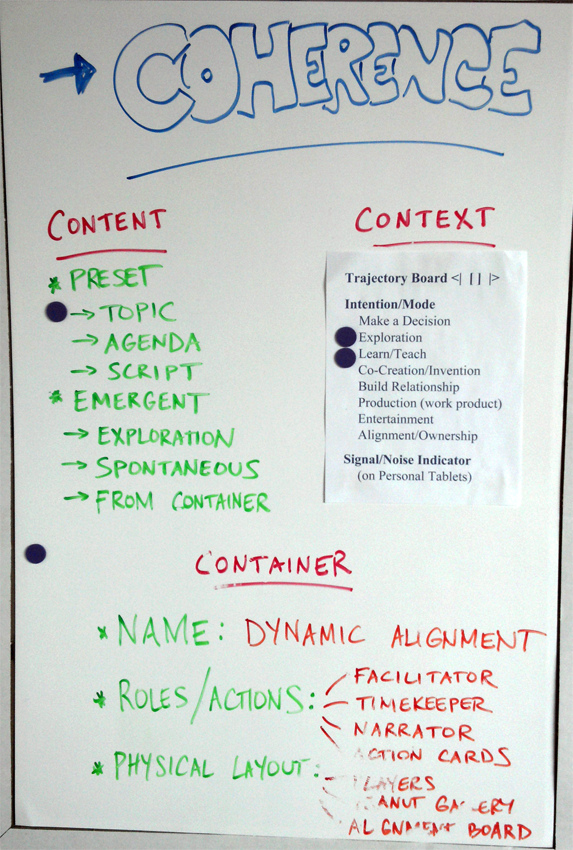
There is a kind of magic that exists in any complex system that keeps the complexity from dissipating. We've been calling that magic, "coherence" and in the case of social processes have identified three aspects of it: the Context, the Container, and the Content.
Content is what the gameshifting session is about. Context is about the mode or intention of the session. Container is the overall structure currently in play. By moving markers on the coherence board participants can see and/or choose explicitly:
1. how content is determined (e.g. was a topic set for the content, or will the content be emergent from the process),
2. what the context is (e.g. is the intention for the session decision making, learning, co-creation, etc.)
3. and perhaps most importantly, specify the rules and actions, as well as the physical layout which make up the container in which the sessions is taking place.
### Player Boards:

Individuals contribute to social processes in many ways. We are most used to spoken contribution, but for successfull social processes, it's crucial to become agile in our capacities to be aware of other levels of being of individuals as they participate. For example, how does the group adjust its pace when things are going too fast or too slow for the participants? How does the group become aware that there is too much noise in the environment and not enough signal? We've added player boards that allow individuals to give this kind of feedback non-verbally.
For example, a spectrum with a triangular arrow indicates individuals feelings about the current pacing: red indicates "slow down!", green signals "speed up!". A bar with a dot allows individuals to set it up as an "!" (exclamation point) to indicate that there is too much distraction or noise in the space, or by moving the dot to the top, turn it into an "i" (for information) to mark that they are experiencing plenty of signal. This form of non-verbal cues allow the group to self-adjust because it can see the emerging whole.
### Sample Player Cards:

## Other Gameshifting Boards
Gameshifting boards have been, and probably should be adapted for different uses, in different groups, and different settings. It is best to use terms and ideas about group dynamics that people are familiar with so that the board doesn't seem to foreign or overwhelming.
Feel free to make your own adaptations. Here are some of the variants that we know of.
### Gameshifting Simplified for Kids
[Arthur Brock](http://emergingleaderlabs.org/Arthur_Brock) adapted Gameshifting for use in [Agile Learning Centers](http://agilelearn.org/) for K-12 kids to run meetings when designing their week, their curriculum or the operations of the school.
The green squiggly box (which says New Rules in it) is the size of an 8.5" x 11" sheet of paper so that you can stick new collections structures in there easily for different types of meetings. This version is a bit easier to play because you can see and manage all the group dynamics on one board.
### Gameshifting - ELL Fall 2013
This configuration is rather detailed, and uses two boards. The Gameshifting Groundrules board is set at the beginning of a session and has the things that are not likely to change much during meeting. The Gameshifting Dynamics board has the social dynamics that you want to change in the course of your meeting.<<--Groundrules 
Dynamics-->> 
Dynamics 2 -->> ( Pretty Printed Version ) 
One nice thing about this set of boards is how it combines the intention of focus of the group with the trajectory icons since those dynamics are, in fact, usually connected. It helps people visualize where they are in a process and what kind of intentions are likely to come next.
### Gameshifting at ALF Summer 2014
This is a simplified version used with for the Agile Learning Facilitator Training as well as with the kids at the ALC Mosaic summer camp. 
### Quaker Community GameShifiting
Some elements of Quaker process had already been showing up on the boards (Clerking, Sense of the Meeting, etc.) but now we customized a GameShifting board for a Quaker Community Retreat: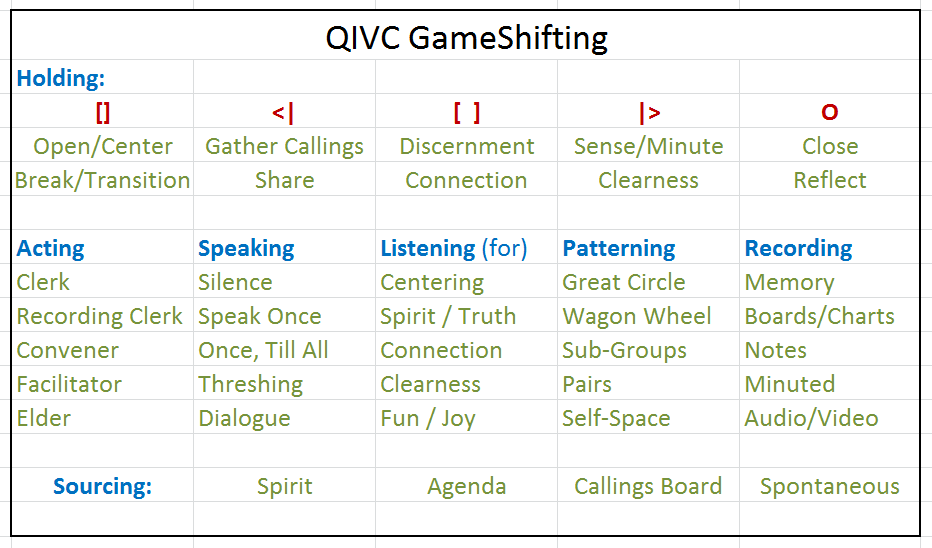
### Various Agile Learning Center Boards

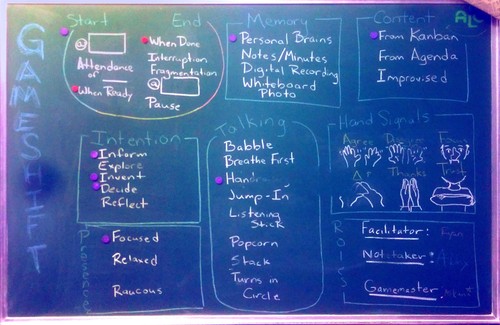

NOTE: This content was sourced from
# Open Space
Open Space Technology is a method of facilitating large group discussions and problem-solving sessions in which participants are free to self-organize and collaborate on topics of interest. The approach was developed in the 1980s by Harrison Owen, an organizational development consultant, as a response to traditional conference formats that he found to be overly structured and often ineffective.
The Open Space Technology process typically begins with an invitation for participants to gather in a large meeting room or outdoor space. The facilitator sets the theme or question for the event, and participants then propose topics of discussion related to that theme. Participants are encouraged to lead or attend any sessions they are interested in, and are free to move between sessions as they please.
Open Space Technology relies on the principle of "self-organization" rather than formal facilitation, and encourages participants to take ownership of the process and outcomes. In this way, it fosters collaboration, creativity, and innovation, and can be used to address a wide range of topics, from business strategy to community building to environmental issues.
Open Space Technology Principles:
1. Whoever comes is the right people: Open Space Technology assumes that whoever shows up is the right person to be there. This principle encourages participants to be open to new perspectives and ideas, and to value the contributions of everyone in the room.
2. Whatever happens is the only thing that could have: This principle encourages participants to be present in the moment and to focus on what is happening right now, rather than worrying about what could have happened or what might happen in the future.
3. When it starts is the right time: Open Space Technology assumes that discussions will begin when they are meant to, and encourages participants to be patient and open to the timing of events.
4. When it's over, it's over: This principle acknowledges that discussions have their own natural lifespan, and that it is important to respect the time and energy of all involved by ending discussions when they have run their course.
Laws:
1. The law of two feet: This law encourages participants to take responsibility for their own learning and to move between discussions as they see fit. If a participant feels that they are not learning or contributing, they are encouraged to "use their two feet" and move on to something else.

# Consent Decision Making
A (facilitated) group process for decision making: invite objections, and consider information and knowledge revealed to further evolve proposals or existing agreements.
Proposals become agreements when they are considered *good enough for now and safe enough to try* until the next review.
Unresolved objections prevent proposals from becoming agreements.
Withholding objections can harm the objectives of a team or organization.
#### Implicit Contract of Consent
1. In the absence of objections to an agreement, I intend to follow through on the agreement to the best of my ability.
2. I agree to share objections as I become aware of them.
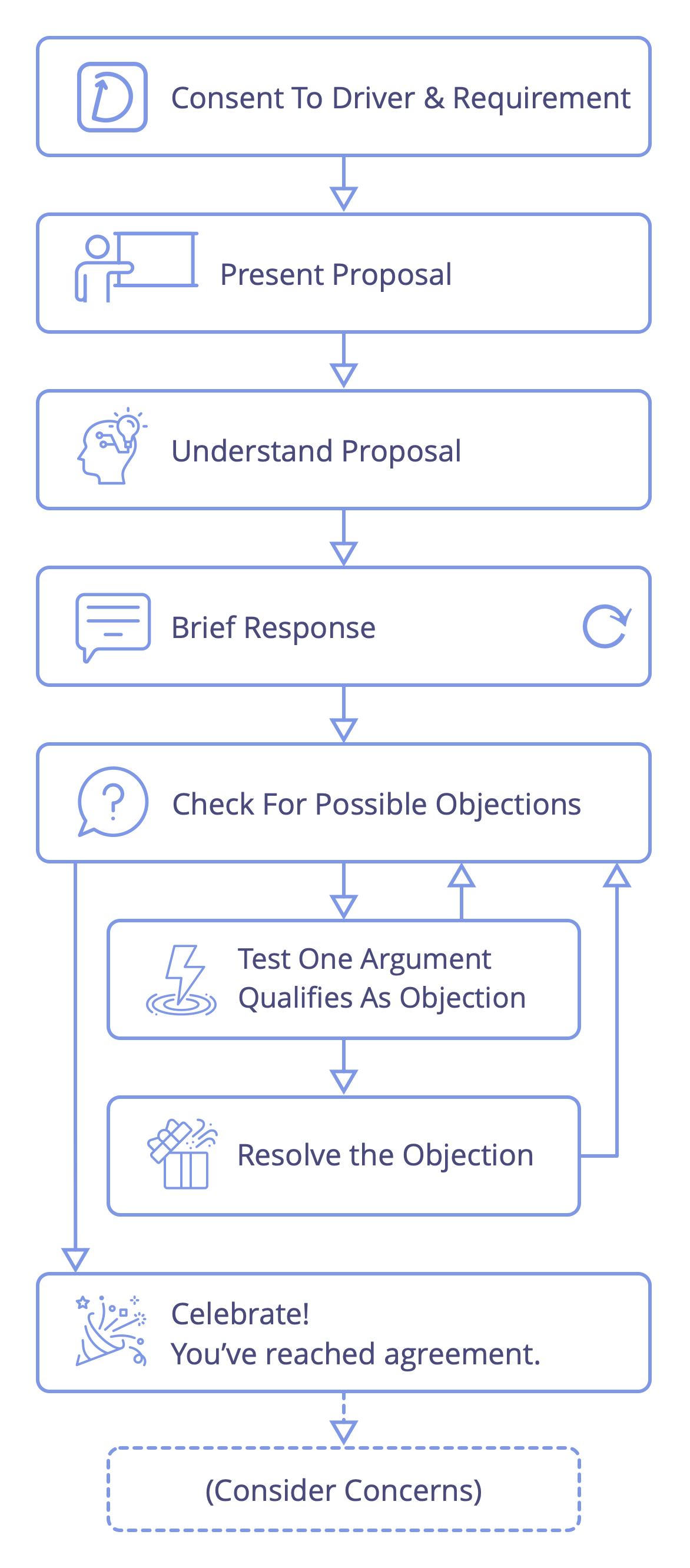
# Navigate Via Tension
Pay attention to tension you experience in relation to the organization, investigate the cause and pass on any organizational drivers you discover to the people accountable for the appropriate domain.
**Challenges and opportunities** for an organization are revealed by people bringing awareness to the reasons why they experience tension.
**Note:** In this context, a *tension* is a personal experience: a symptom of dissonance between an individual’s perception of a situation, and their expectations (or preferences).
To **discover drivers**, investigate what stimulates tension, and describe what’s happening and what’s needed. Sometimes an inquiry reveals misconceptions and the tension goes away.

# Rock, Paper, Scissors Proficiency
Participants can indicate their proficiency to other (eg: by wearing a sticker). This can also change in time.
**Rock:** coders, handy-man, everyone that would like to get their hands dirty and just build, with or without a plan.
**Paper:** architects, system thinkers, everyone that would like to draw, discuss and iterate on the plan of execution.
**Scissor:** Decorators, UX designers, graphic designers, crafters, artisans, etc.. the touch that would bring what the rock and paper have created into a beautiful piece of art.
Proficiencies can be used to form balanced and complete teams, or to organize activities / workshops focused on a specific proficiency.
# Driver Mapping
A workshop format to identify an effective response to a complex situation: organize start-ups, kick-off projects, tackle major impediments or opportunities, develop organizational structure to better enable the flow of value.
A (small or large) group identifies and clusters drivers, to then progress quickly from concept to action in smaller and self-organizing teams.

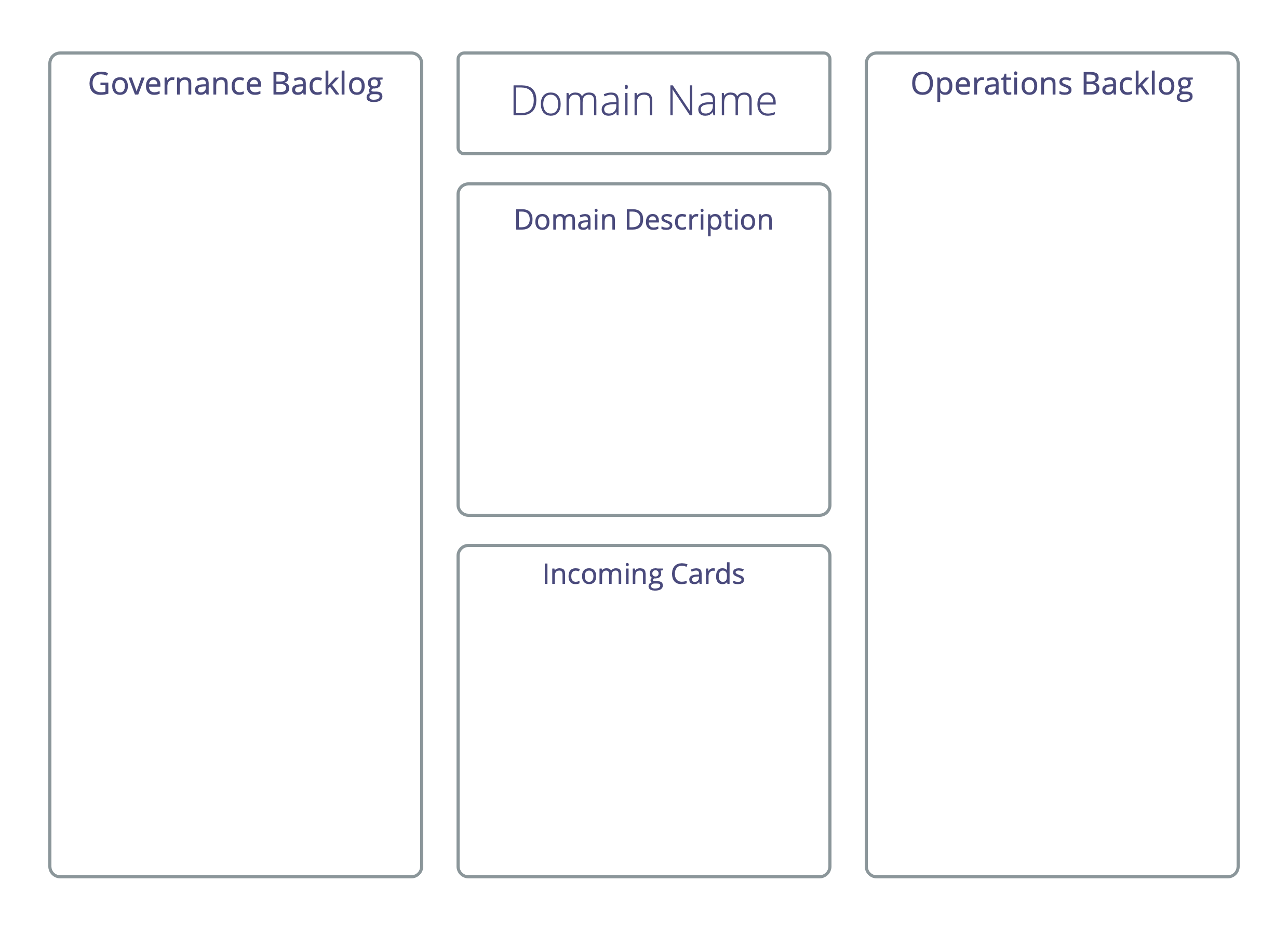
# Role Selection
A group process for selecting a person for a role on the strength of the reason.
Instead of simply assigning people for [roles](https://patterns.sociocracy30.org/role.html), or making a choice based only on majority, use the role selection process to:
* tap collective intelligence by hearing and deliberating on reasons for nominations
* increase ownership over the decision
* ensure support for the role keeper by those affected.
A prerequisite to the selection process is a [clear description](https://patterns.sociocracy30.org/clarify-domains.html) of the role’s domain.
#### Role Selection - Steps
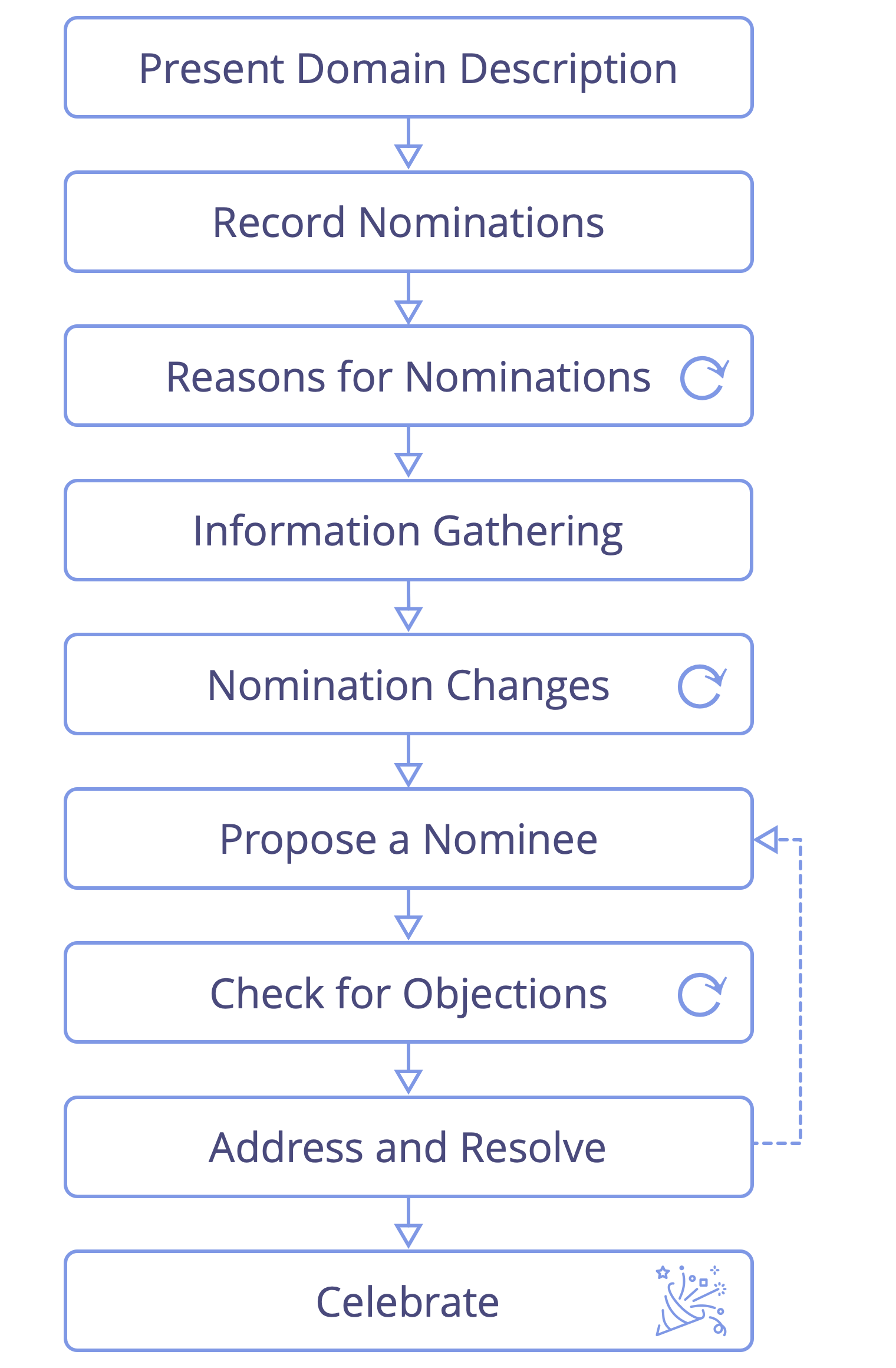
1. **Present Role Description:** If possible, send out the role’s domain description in advance.
2. **Record Nominations:** Participants write their nomination on a slip of paper. People can nominate themselves, another, or pass.
3. **Reasons for Nominations:** Each person shares who they have nominated and why.
4. **Information Gathering:** Participants share or request any information that might support the group in making an appropriate selection.
5. **Nomination Changes:** Check if anyone wants to change their nomination in light of reasons and information shared so far, and hear the reasons for each change.
6. **Propose a nominee** for the role: The facilitator guides the process to identify a suitable nominee on the strength of the reasons heard, e.g. by:
* proposing a nominee themselves or asking a group member
* inviting (some) nominees to agree who should be proposed
* inviting group dialogue to help reveal the strongest nominee
7. **Check for Objections:** Ask participants (including the proposed nominee) to simultaneously signal whether or not they have an objection.
8. **Address and Resolve Objections,** beginning with any from the proposed nominee. [Objections may be resolved](https://patterns.sociocracy30.org/resolve-objections.html) in many ways, including amending the role’s domain description or by nominating someone else. When all objections are resolved, check with the (final) nominee again if they accept the role.
9. **Celebrate:** Acknowledge reaching agreement and thank the person who will now keep the role.
To avoid influencing others, abstain from expressing personal interest or opinions before a selection takes place.
Sometimes a role selection reveals a lack of capacity, relevant experience, qualities or skill. A group will then need to consider outside candidates, reconsider priorities or find an alternative way to account for the domain.
This pattern can also be used in any situation where there is a need to choose between a variety of options.
# Co-Create Proposals
Bring people together to co-create proposals in response to organizational drivers: tap collective intelligence, build sense of ownership and increase engagement and accountability.
There are many ways to co-create proposals. They typically follow a similar pattern:
1. Agree on the driver (or problem / opportunity / need)
2. Explore the topic and understand constraints
3. Generate ideas
4. Design a proposal (often done by a smaller group)
One way to co-create proposals is to use S3’s [Proposal Forming](https://patterns.sociocracy30.org/proposal-forming.html) pattern.
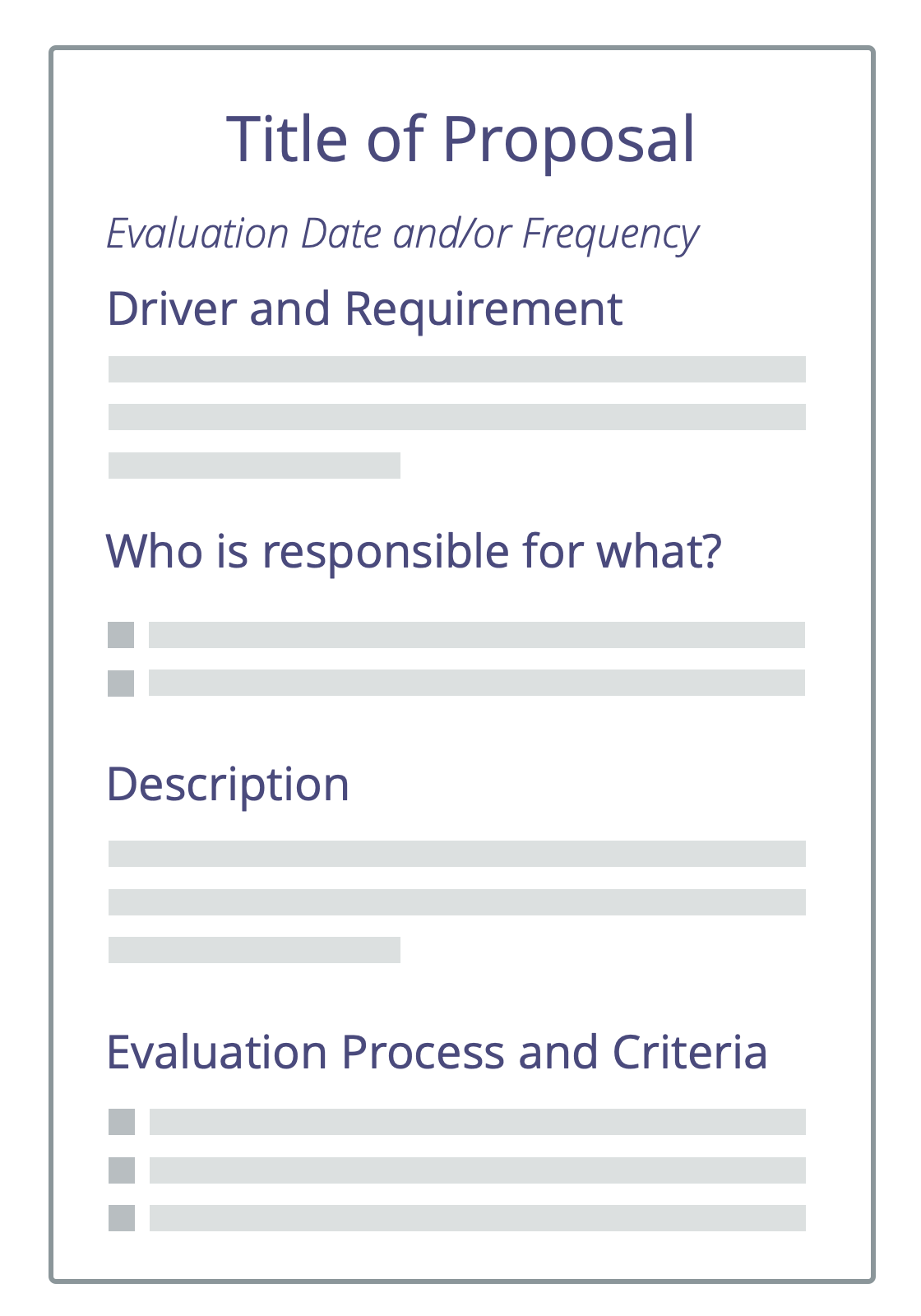
For inspiration for steps 2 and 3, look to classic group facilitation techniques or design thinking activities.
Besides in a face-to-face workshop, you can adapt this process for online meetings. You can even use it asynchronously (and over an extended period of time) to include many people.
# Resolve Objections
Resolve objections one at a time by using the information they contain to make and evolve amendments.
Choose an option for resolving an objection that looks most promising and, if that fails, simply pick another one. Each attempt will help you understand more of the information the objection contains, and bring the group closer to proposing an amendment that resolves the objection.
Often, asking the person who brings the objection to propose an amendment, is a productive place to start.
Typically it’s most effective to **take one objection at a time**, resolve all objections to a proposed amendment, and then continue with the next main objection.
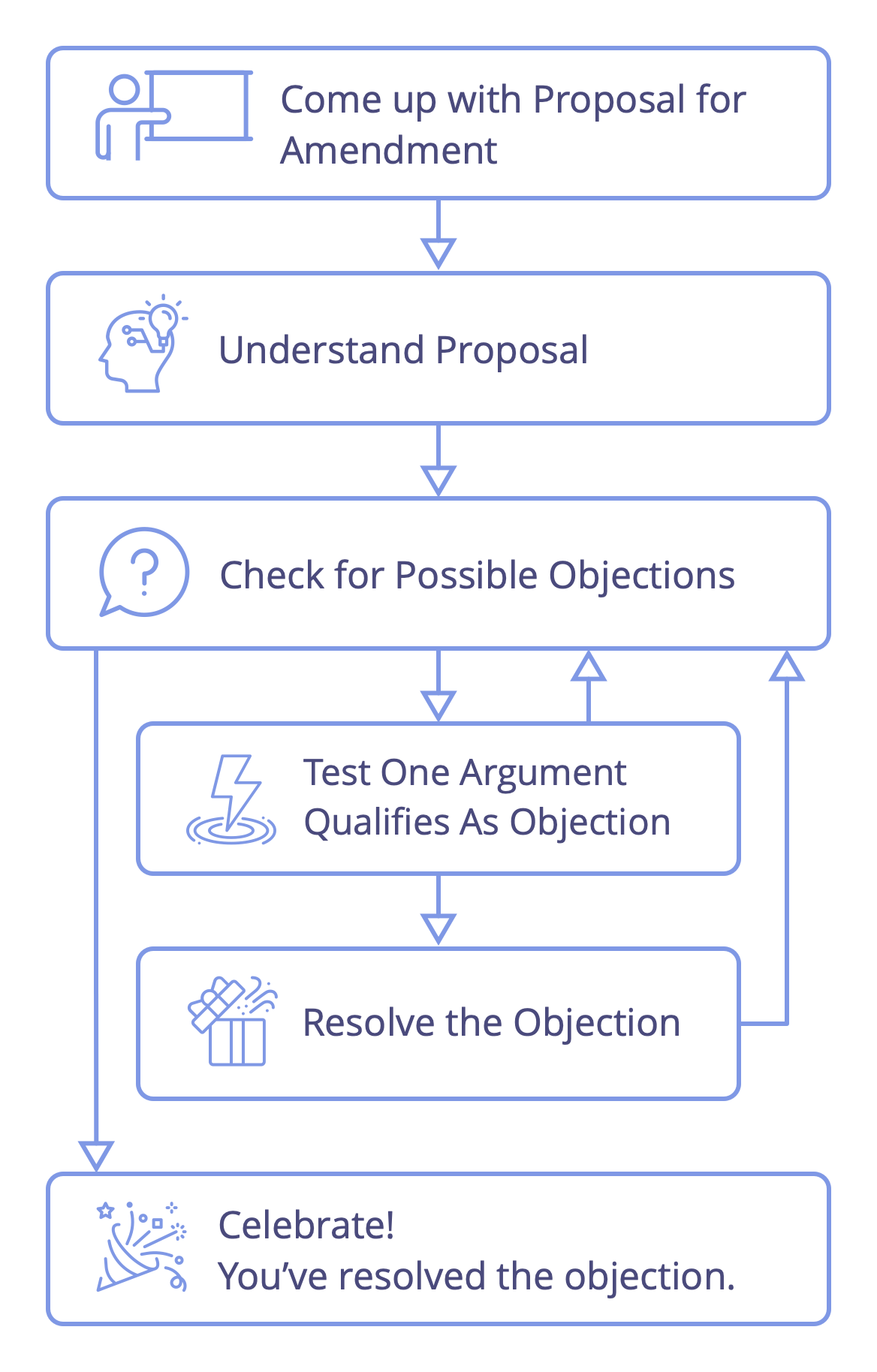
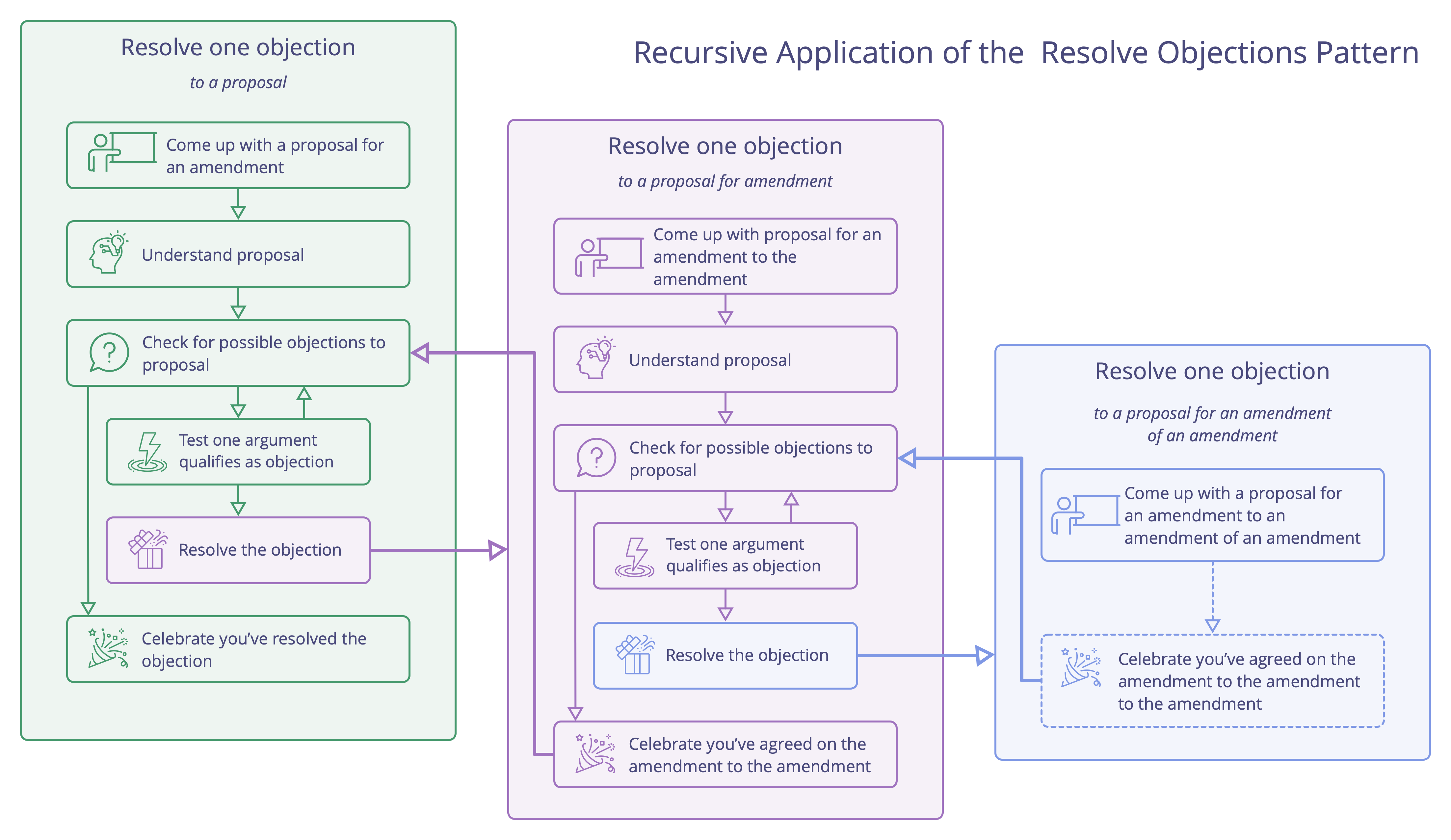
# Communication Patterns
Communication between people and teams are fundamental for good collaboration. These patterns aid people to feel included by speaking their mind and finding commonalities, while reducing effects of egos within the group.
# MonoLogs, DiaLogs, TriaLogs
**Monologues**
Monologues are a way to share knowledge or realization which are crystalized enough.\
They take the form of a snippet of text, all the way to a TED-style presentation or an interactive workshop. The person talks about life, realizations, teaches, or showcases or something known or realized, and deemed relevant to others. Although the topics and context are set, monologues could lead to very diverse conversations and Q\&As with multiple peers.
As self-contained sessions, monologues are often audio/video-recorded or transcribed in the forum so that everyone will be able to participate asynchronously.
**Dialogues**
Monologues are not necessarily the best way to share ideas and knowledge. They do not allow debate, it requires lots of preparation and presentation skills. Furthermore, monologues do not enrich personal relationships, and any gap in the knowledge of the audience will most likely not be addressed during the monologue (eg: “what’s blockchain?”).
The informal setup of dialogues allows the participants to go deep into a personal conversation, and establish trust links between the people. They can speak at any lengths about their lives, their projects and anything else that’s relevant to both of them. Gaps in knowledge are quickly filled by directly addressing each question. Assuming there is enough time to have multiple dialogues with the participants, dialogues enrich intrapersonal relationships and trust between the participants.
The [Buddy System](https://async.hackalong.io/t/pattern-buddy-system/52) can be used to facilitate dialogues between two or more people while performing the same task.
**Trialogues**
Trialogues are three-way conversations. The dynamics of these conversations are very different from dialogues, as they do not usually allow for deep personal conversations and knowledge sharing. They are, however, very useful for brainstorming (two people discuss a topic, while the third one takes one side or the other, or proposes a new perspective)
**Forums**\
Forums are moments and places where an undefined amount of people get together to share what they deem relevant for everyone. Forums can be both synchronous (eg: an announcement after breakfast) or asynchronous (eg: writing an item on the local board or an online forum). The content should be kept as distilled as possible to avoid turning into a monologue or public dialogue/trialogue.
Learnings from monologues, dialogues, and trialogues should be logged in an asynchronous forum (eg: under the DiaLOGs category) so that interested people can learn and participate in the conversation.
\#kudos\
@ome\
[@joshafairhead](https://async.hackalong.io/u/joshafairhead)
# Imago Dialogue
Mirror, Validate, Empathize
A structured communication practice that creates deep listening, mutual understanding, and emotional safety through three core steps: Mirror (reflect what you heard), Validate (acknowledge it makes sense), and Empathize (connect with feelings).
Imago Dialogue transforms reactive conversations into conscious connection, making it especially powerful for navigating conflict, processing emotions, and building trust in community settings.
## Overview
Imago Dialogue is a communication technique developed for couples therapy but highly effective in any relationship context - partnerships, community conflicts, team tensions, or healing conversations. It creates a structured container where one person (the Sender) shares while the other (the Receiver) listens deeply and reflects back without defending, explaining, or responding with their own perspective.
The practice slows down communication, creates safety through mirroring, and ensures both people feel heard before moving to problem-solving or response.
## Why Use Imago Dialogue
**Prevents Reactive Loops:** By requiring the Receiver to mirror before responding, it interrupts the reactive pattern of defending, explaining, or counter-attacking.
**Creates True Listening:** Most people listen to respond, not to understand. Mirroring forces genuine listening since you must accurately reflect what was said.
**Builds Psychological Safety:** Validation and empathy create safety even in difficult conversations, allowing deeper truth to emerge.
**Surfaces Hidden Feelings:** The structured empathy step helps name emotions that might be present but not explicitly stated.
**Equalizes Power:** Both people get equal time and attention. The structure prevents dominant personalities from overwhelming quieter voices.
**Enables Repair:** When relationships are strained, Imago creates a pathway back to connection through structured mutual understanding.
## The Seven Steps (for the Receiver)
### Step 1: Agree to Talk
**Grant your partner's request ASAP** - When someone asks for an Imago conversation, honor that request as soon as possible. If now doesn't work, give a rain check within 24 hours: "I can't right now, but let's talk at 7pm tonight."
**Why this matters:** Delayed conversations allow emotions to fester. Committing to a specific time shows the request is valued.
### Step 2: Listen & Reflect Back - Prepare
**Pause, go inside, clear your mind if needed, center yourself** - Take a few breaths. Set aside your own agenda, defensiveness, or the story you're telling yourself. Arrive present.
**Tell your partner when you're ready to begin** - "I'm ready to listen" signals you've settled and are fully available.
### Step 3: MIRROR
**Reflect back exactly what you heard** - "What I heard you say is..." Repeat their words as accurately as possible. Don't paraphrase, interpret, or add your own spin.
**Check it out** - "Did I get you?" This gives the Sender a chance to clarify or correct.
**Ask for more** - "Is there more about that?" Keep inviting until the Sender has fully expressed.
**Listen & Pause** - Pause for reflection between each mirroring cycle.
**Repeat all steps until Sender says there's no more** - Continue mirroring, checking, and asking for more until the Sender feels complete.
**If very much has been said: Summarize** - "If I got it all, you said..." This helps consolidate longer shares.
**Example:**
* Sender: "I feel frustrated when meetings start late because my time isn't being respected."
* Receiver: "What I heard you say is you feel frustrated when meetings start late because your time isn't being respected. Did I get you?"
* Sender: "Yes, and it makes me not want to come to meetings anymore."
* Receiver: "And it makes you not want to come to meetings anymore. Did I get that? Is there more?"
### Step 4: VALIDATE
**Two choices:**
**Option A - Affirm:** "You make sense to me because..." Explain why their perspective is logical, even if you see things differently. You're not agreeing, just acknowledging their view makes sense from their experience.
**Option B - Seek Clarification:** "Help me understand. Can you say more about 'X'?" If you can't yet see how it makes sense, ask for more information.
**Check it out** - "Does it feel like I'm getting you?"
**If Sender doesn't feel understood:** "What would feel more validating?" Give them a chance to guide you toward what would help them feel heard.
**Example:**
* Receiver: "You make sense to me because when we've committed to a time and then start late, it does communicate that your time isn't valued as much as the person who's late. Did that feel validating?"
### Step 5: EMPATHIZE
**Name the possible feelings** - "I can imagine you might be feeling..." Use the emotion words that seem present. Reference the Negative Feeling Prompters if helpful: frustrated, sad, lonely, overwhelmed, betrayed, hurt, angry, anxious, abandoned, etc.
**Check it out** - "Is that how you're feeling?"
**Adjust based on feedback** - If you named the wrong emotion, ask "What are you feeling?" and mirror their answer.
**Example:**
* Receiver: "I can imagine you might be feeling frustrated and maybe even disrespected. Is that how you're feeling?"
* Sender: "Yes, frustrated for sure, and also just tired of bringing it up."
* Receiver: "Frustrated and tired of bringing it up. I get that."
### Step 6: EMPATHIZE - Check It Out
**Confirm emotional accuracy** - "Is that how you're feeling?" Make sure you've identified the right emotions.
### Step 7: END / Ask to Switch
**Thank them for sharing** - "Thank you for sharing this with me." Acknowledge the vulnerability it took.
**Check their state** - If the Sender doesn't smile or seem relieved, they may not feel fully heard yet. Ask: "May I respond?" or "Is there anything else?"
**Decide on next steps** - Sometimes the Sender just needed to be heard and the conversation is complete. Sometimes it's time to switch roles (they become Receiver, you become Sender). Sometimes you need a break before continuing.
## The Sender's Role
**Request the conversation** - "I'd like to have an Imago dialogue. Are you available now or can we schedule a time?"
**Share from your experience** - Use "I" statements. "I feel..." "I notice..." "I need..." Don't attack or blame.
**Allow mirroring** - Pause after each thought to let the Receiver mirror back. Correct them if they didn't get it right.
**Go deeper when asked** - When Receiver asks "Is there more?" check in with yourself. Is there more under the surface?
**Guide validation** - If validation doesn't land, help them understand what would feel validating.
**Name your feelings** - When they empathize, honestly say what you're feeling. Don't minimize or hide emotions.
## Negative Feeling Prompters
These emotion words can help identify what the Sender might be experiencing:
**Anger cluster:** frustrated, irritated, angry, hurt, criticized, attacked, depressed
**Sadness cluster:** sad, anxious, helpless, hopeless, insecure, scared, rejected
**Loneliness cluster:** lonely, alone, abandoned, controlled, pressured, smothered, trapped
**Overwhelm cluster:** overwhelmed, unheard, discounted, invisible, unloved, confused, manipulated
**Betrayal cluster:** betrayed, cheated, embarrassed, guilty, humiliated, ashamed, enraged
## When to Use Imago Dialogue
**Conflict resolution** - When tensions arise and you need to understand each other's perspectives before solving the problem.
**Processing emotions** - When someone is carrying difficult feelings and needs to be fully heard and validated.
**Repair after rupture** - When trust has been broken and you need to rebuild connection.
**Deepening intimacy** - For sharing vulnerabilities, fears, dreams, or needs in a safe container.
**Decision-making** - Before making decisions together, use Imago to ensure all perspectives are fully understood.
**Community tensions** - When interpersonal dynamics are affecting group cohesion.
## Tips for Success
**Set aside time** - Don't rush Imago. Allow at least 30-60 minutes for a full exchange where both people get to be Sender and Receiver.
**Minimize distractions** - Turn off phones, close laptops, create a quiet space.
**Stay in structure** - The formality might feel awkward at first, but the structure is what creates safety. Don't skip steps.
**Mirror exactly** - Resist the urge to paraphrase or "fix" their language. Mirror their actual words.
**Validate doesn't mean agree** - You can validate someone's perspective makes sense from their experience while still having a different view.
**Empathy requires guessing** - You might name the wrong emotion. That's okay - they'll correct you.
**Switch roles** - After the Sender feels complete, switch. The Receiver becomes Sender and gets equal time to share their perspective.
**Practice regularly** - Don't wait for crisis. Use Imago for positive sharing too: appreciations, dreams, desires.
## Application in Regenerative Communities
**Consent-based culture** - Imago creates the deep understanding needed for genuine consent rather than compliance.
**Healing from extractive systems** - Many people carry trauma from being unheard, invalidated, or dismissed. Imago provides corrective experience.
**Cross-cultural communication** - The structured mirroring helps bridge different communication styles and cultural norms.
**Power dynamics** - The equal turn-taking prevents those with more social power from dominating conversations.
**Distributed coordination** - Remote communities can practice Imago over video calls, creating connection despite physical distance.
**Conflict transformation** - Rather than avoiding or suppressing tensions, communities can work with them productively through Imago.
## Variations
**Group Imago** - One person shares while the whole group practices mirroring, validation, and empathy collectively.
**Written Imago** - Exchange letters following the Imago structure - useful for remote communities or when emotions are too intense for face-to-face.
**Appreciative Imago** - Use the structure to share gratitude and appreciation, building positive connection.
**Quick Imago** - In time-limited situations, focus just on mirroring and validation, saving full empathy for later.
## Related Patterns
* **Sharing Circle:** Another structured practice for deep listening, but in group format
* **Non-Violent Communication:** Complementary framework for expressing feelings and needs
* **Psychological Safety:** Imago builds the safety needed for vulnerable sharing
* **Monologs, Dialogs, Trialogs:** Imago is a specific form of Dialog (two-way exchange)
* **Navigate via Tension:** Use Imago to explore tensions in relationships and systems
## Resources
Imago Dialogue was developed by Dr. Harville Hendrix and Dr. Helen LaKelly Hunt. For more information, see imagoworks.com.
Practice is essential - Imago feels artificial at first but becomes natural with repetition. The structure creates the safety that allows true spontaneity and authenticity to emerge. In regenerative communities where deep trust and mutual understanding are foundational infrastructure, Imago Dialogue is a practical tool for building and maintaining that relational coherence.
# Sharing Circle
### Set-up
Prepare the room where we will share, setting up a circle of chairs and/or cushions. If you have the chance to be outside and have a small bonfire for people to gather around even better!
Create a comfortable, inviting, safe environment. Eg. lowlights or candles, comfy seating, if possible have some blankets if cold. Importantly add something to the centre of the circle that is pleasing to look at. Eg, candles, fairy lights, plant, flowers…
When welcoming people into the space, keep silence or a mindful presence.
### Introducing the circle
For many many many generations humans gather, sat in circles around the fire, and shared with others their stories, visions, feelings… To celebrate, process and dialogue as a community.
And for many many many generations others sat with them to listen… to witness what needed to be shared, to hold space for others to be heard…
A sharing circle is a safe space where we practice honest, vulnerable sharing, and deep non-judgemental listening.
There can be a calling question, topic or idea. Or just be a space to share what is alive in your heart, body and mind.
### Guidelines
There may be some questions people have, especially if is their first time in a sharing circle.
These are some guidelines you can speak out. You may want to remove or add different guidelines according to your context:
* We share our truth to the circle. We don’t speak directly to a particular person. We don’t seek an answer, don’t reply to what someone has said, or seek to open a conversation.
* There’s no speaking order, we don’t go around the circle one by one, we don’t lift our hand or seek permission to speak. We share when we are ready, but only share one time.
* If there’s a limited amount of time for the circle (I recommend 2hrs max), be mindful of the amount of time you take, leave enough space for others.
* How do you know when is your time to speak?... Your heart will give you the cue, if it starts pumping is because it has something to say.
* Not everyone has to speak, only if you feel like it.
* We don’t interrupt people, we make sure they finished sharing and we leave a few seconds of silence before we speak.
* There may be some moments of long silence, that’s ok!
* As the circle holder I may check in long silences to see if we are complete by asking “Is there anything else that wants to be said in this circle?”, and give more time for the quiet voices to gain courage to share. This may be repeated a few times until I close the circle.
* We don’t laugh or comment to what someone has shared, we just witness. If you feel moved or touched by what they have said you can use ‘sparkle fingers’ to signal
* This hand signal can also be useful if you feel that the person speaking may need some support or courage to share.
* We try to hold a space of presence and reverence for what is shared.
* Everything that is shared in this circle is in a confidentiality context, please don’t share any personal details about what is said here with anyone else outside this group.
* If what you listen triggers some strong emotions in you, I invite you to stay present with your feelings and just observe them.
* If the emotions are too much you can also leave the circle to be alone. You may also return later on.
* If when you share or listen you feel moved to cry, is ok! Please don’t apologise, you and your emotions are welcome here.
### Starting
So when the space is set, I ask people to take a couple of minutes to center themselves and I open the circle by reminding the calling question/topic/idea, and saying “the circle is open… what wants to be said?”
### Ending
You can set up a time frame and finish then; you can give an estimate and check after a certain time has passed how much energy there is to continue; or you can finish when everyone that wanted to share has done so.
With a group of around 20 people I try to keep it shorter than 2 hrs if possible (this gives everyone between 3 and 5’ to share if they feel like it, also allowing for some silence), as holding the kind of attention and emotional presence needed to be in a sharing circle can be exhausting for people.
After checking a couple of times ‘if there’s anything else that wants to be shared?’ if it doesn’t seem there’s anyone else moved to do so I’ll close the circle by giving thanks to anyone that shared and listened and saying: ‘the circle is now closed...’
[**CC-BY-SA**](https://creativecommons.org/licenses/by-sa/2.0/) **credit Natalia Lombardo @ TheHum.org**
# "We" Proposals
This pattern is about funnelling sentences that express a personal need into sentences that we can all use to express the needs of the group as a whole. This may help us to understand what we have in common, make decisions, and work independently.
For example, we might all say sentences that start like these:
‘I need Hack-Alongs to’, ‘I want Hack-Alongs to’, ‘My goal for Hack-Along is’, ‘My values for Hack-Along are’
Here, we can understand each other's feelings and needs related to the group so that we can all confidently and with full honesty and authenticity say:
‘We need for Hack-Alongs to’, ‘We want Hack-Alongs to’, ‘Our goal for Hack-Along is..’Our values as Hack-Along are’
To do this, someone anonymously suggests a 'We' statement that in good faith they believe the group shares.
Once written, the We statement should not be changed so that everyone has a chance to respond to the same statement. (New ones can be added as frequently as we like to refine the statement!)
Then everyone (including the anonymous poster!) writes how they feel about that with as many 'I' statements as they like.
For each 'I' statement, the responsder should also include how they feels this agrees or disagrees with the proposed 'We'
If the responder feels it Agrees, they enter 'Agree'.
If the response does not directly agree or disagree with the proposal, enter 'Neutral'
If the response disagrees, enter 'Disagree'
If everyone Agree's, the 'We' gets saved to the 'We' tab!
If there is any Disagree or more than one Neutral, it goes to 'I'!
If people don't respond, it stays here, forever, and ever.
Here is an example, in a group with 3 Members only: James, Bob, Alice
We can see that someone suggests that a value of the group is creativity.
Bob confidently says 'I value creativity' as well - and Agrees!
When Alice thinks about creativity it makes her think about freedom of expression instead, so she writes that. She might still say that 'freedom of expression' is the same as creativity and Agree, but she chooses No Opinion
James says 'I value structure' which he feels is in opposition to the Proposal so he Disagrees
# Group Sign Language
This allows people to communicate while others are speaking, without the need to interrupt the speaker (eg: non-violent communication)
Sign gestures are used to facilitate meetings in a decentralized fashion.
Here is a list of useful signs, feel free to adapt depending on the context.
**Sparkly fingers:** I love what you are saying, i couldn't agree more.
**Raising one hand**: I would like to ask a question or add something to what you are saying.
**Rolling hands:** This explanation is getting too long, please get to the point.
**Hat hands (A.k.a. STFU)**: I've heard enough from this speaker, i would like to hear someone else's opinion or change topic.
**Two hands up (A.k.a. "pop the stack")** let's get back to what we were discussing before.
**Two hands pointing at a person (a.k.a. pass the mic):** I would like to hear this specific person. This can be done either by the person currently speaking, or by other participants in case they feel the pointed person is not being heard.
# Color-Coding Talks
Colors can be used to indicate of the type of talk or workshop:
Eg: Green is for everyone, even if you are not familiar with the concept
Yellow is for the people that are knowledgeable about the subject but still have to figure things out
Red is for deep-dives, and requires prior knowledge (please indicate which one)
# Healing Patterns
Healing patterns are meant to be used on a personal level, to decondition ourselves from systemic conditioning of our life and the way we think about ourselves and the world around us.
# The Seven A’s
The following is taken from Chapter 19 of Gabor Mate’s book When the Body Says No; Exploring the Stress-Disease Connection by Gabor Mate, M.D.
“Pursuing the seven A’s of healing will help us grow into emotional competence. Emotional competence is the capacity that enables us to stand in a responsible, non-victimized, and non-self-harming relationship with our environment.”
1\. Acceptance
To heal we don’t need to be perfect, we only need to accept ourselves as we are at this moment and time and see ourselves as whole despite whatever we may feel we are lacking. We approach ourselves with compassionate curiosity, as we would anyone else who was suffering.
2\. Awareness
We learn to be aware of what our bodies tell us, and do not necessarily rely on our intellect alone. As we learn to be aware of the internal messages our body tells us, we learn to trust these messages to guide us in our lives and to gauge our level of distress.
3\. Anger
Often times disease and disorder manifests due to one’s inability to genuinely experience anger. We either learn to turn it inward on ourselves, or outward in rage. However, there is an alternative. We can learn to experience and feel anger deeply, and to let it appropriately inform us of our environment or situation. We then are empowered with a choice of whether or not and how to express this anger.
4\. Autonomy
Through the development of appropriate boundaries, we can learn to sense and understand where we begin and end in relation to others. We are then able to identify our internal centre of control, and are able to authentically articulate our life experience.
5\. Attachment
Being connected to others and having meaningful relationships is a proven indicator of favorable outcomes in regards to health. When we know and feel that we can truly rely on others and share our vulnerabilities, we are better able to love ourselves and overcome life’s obstacles.
6\. Assertion
Assertion does not necessarily mean that we must act out or speak up, although at times this is in our best interest. In this case, to assert one’s self means to truly be who we are in this world. Instead of acting, this notion encourages being, and taking up the space that is our birthright on this earth.
7\. Affirmation
There are two values that we can affirm to help us heal. The first value is our creative nature, our need to express ourselves and be connected to some kind of creative energy. The second affirmation is of our connection with the universe, with something greater. We remember that “we are a part of the universe with temporary consciousness, but never apart from it.”[ ](https://barefootlivingarts.org/blog-2/2019/2/20/rhythm-and-emotional-regulation-a-case-for-sheng-zhen-and-it-rhythmical-patterns)
# The three 7s
This exercise is meant to apply gratitude and forgiveness and positive reinforcement to oneself.
Take some time to think about it, then write down 7 things you are proud of yourself, 7 things you forgive yourself for and 7 things you want to commit yourself to.
These sentences should be used as a daily mantra (eg: speaking them to yourself once a day while looking at the mirror).\
\
Repeat for at least a month, or for as long as necessary.
Source: Lisa Nichols
# Internal Family Systems
Internal Family Systems (IFS) is a therapeutic model developed by Dr. Richard Schwartz in the 1980s. It is based on the premise that the human psyche is made up of multiple parts or subpersonalities, each with its own thoughts, feelings, and behaviors.
According to IFS, some of these parts are in a healthy state and are able to function well, while others are stuck in negative patterns and are causing distress or dysfunction.
The goal of IFS is to help individuals develop a better relationship with these different parts of themselves, and to learn to work with them in a more integrated and compassionate way. This can involve identifying and acknowledging different parts of oneself, understanding their roles and motivations, and learning to communicate with them in a way that fosters self-awareness and self-compassion.
In a group setting, IFS can be practiced in a number of ways. One approach is to use guided meditations or visualizations to help group members connect with different parts of themselves and explore their roles and motivations. Another approach is to use group discussions or exercises to help individuals share their experiences and insights, and to provide support and feedback to one another.
Group sessions can also provide a safe and supportive environment for individuals to explore and work through difficult emotions and experiences, and to develop greater self-awareness and self-compassion.
The first step in IFS is often to identify the different parts of yourself and give them names or labels. For example, you may have a "protective" part that tries to keep you safe from harm, a "critical" part that judges and criticizes you, or a "pleaser" part that seeks approval from others.
Once you have identified your parts, the next step is to begin working with them. This may involve visualizing and interacting with them in a safe and supportive environment, learning to understand their motivations and needs, and developing strategies for integrating them into your overall sense of self.
Ultimately, the goal of IFS is to help you develop greater self-awareness and self-compassion, while also learning to work with your parts in a way that promotes healing, growth, and overall well-being.